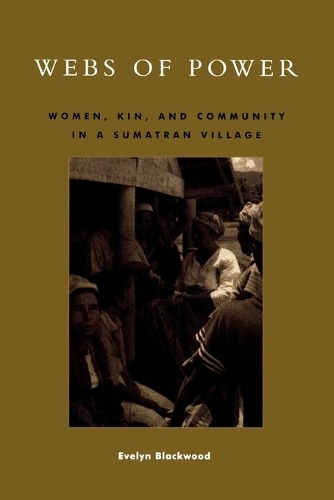
Webs of Power offers a fresh perspective on women in Southeast Asia. Focusing on one rural Minangkabau village, the book provides vital insights into the gendered processes of post-coloniality. The Minangkabau living in West Sumatra are the largest matrilineal group in the world. They have intrigued generations of scholars because they are matrilineal and Islamic. By exploring the contestations and accommodations women and men make with state and Islamic ideologies, Webs of Power discloses the processes at the heart of globalization as well as the complexities of kinship and power in a rural agricultural community. The book challenges conventional thinking about matriliny, showing the prominence of senior women in all aspects of village life.
"The book is detailed yet has a readable style. Recommended." - CHOICE
"In this well-written and informative ethnography of a Minangkabau village in West Sumatra, Indonesia, Evelyn Blackwood offers a detailed picture of how social relationships centered on kinship and rank are negotiated, contested, and cemented through everyday practices. It is a valuable contribution to the growing literature on women in Indonesia and in Southeast Asia more broadly, as well as to the anthropological literature on kinship and matrilineal societies." - Journal of Asian Studies
"...Insights into the internal dynamics of power and the intertwining nature of 'domestic' and 'public' spheres of influence provides a fascinating story and analysis." - Development and Change
"Students and scholars of Southeast Asia will find this to be an important contribution to the ongoing process of rethinking gender and power in the region." - Ethnos
"Webs of Power is certainly a convincing study of matriliny in practice." - Royal Anthropological Institute Of Great Britain and Ireland