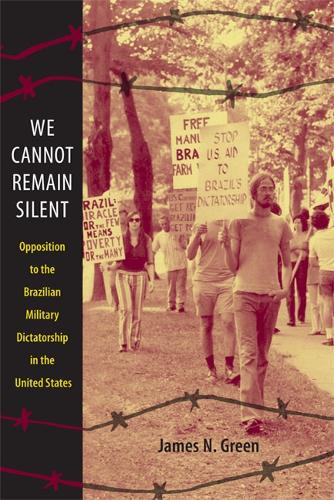
Книга We Cannot Remain Silent: Opposition to the Brazilian Military Dictatorship in the United States
Political and cultural history examining open opposition (in both the US and Brazil) to the Brazilian military dictatorship shows how these efforts helped form a transnational conversation about human rights.
In 1964, Brazil’s democratically elected, left-wing government was ousted in a coup and replaced by a military junta. The Johnson administration quickly recognized the new government. The U.S. press and members of Congress were nearly unanimous in their support of the “revolution” and the coup leaders’ anticommunist agenda. Few Americans were aware of the human rights abuses perpetrated by Brazil’s new regime. By 1969, a small group of academics, clergy, Brazilian exiles, and political activists had begun to educate the American public about the violent repression in Brazil and mobilize opposition to the dictatorship. By 1974, most informed political activists in the United States associated the Brazilian government with its torture chambers. In We Cannot Remain Silent, James N. Green analyzes the U.S. grassroots activities against torture in Brazil, and the ways those efforts helped to create a new discourse about human-rights violations in Latin America. He explains how the campaign against Brazil’s dictatorship laid the groundwork for subsequent U.S. movements against human rights abuses in Chile, Uruguay, Argentina, and Central America.
Green interviewed many of the activists who educated journalists, government officials, and the public about the abuses taking place under the Brazilian dictatorship. Drawing on those interviews and archival research from Brazil and the United States, he describes the creation of a network of activists with international connections, the documentation of systematic torture and repression, and the cultivation of Congressional allies and the press. Those efforts helped to expose the terror of the dictatorship and undermine U.S. support for the regime. Against the background of the political and social changes of the 1960s and 1970s, Green tells the story of a decentralized, international grassroots movement that effectively challenged U.S. foreign policy.
"“We Cannot Remain Silent makes a substantial contribution, both methodologically and theoretically, to understanding the role of aesthetics and emotions in framing and resource mobilization processes. It is also an important example of the use of oral histories in studying the construction of activist identities. In addition, the book provides methodological elements in the analysis of affinity networks and frame convergence that can be used in other social movement case studies.”" - Mobilization
"“We Cannot Remain Silent is an important book that deserves to be read by a wide audience. Human rights activists, Latin American specialists, and students of U.S. foreign relations can learn much from Green’s analysis of the campaign to end human rights abuses in Brazil. This book makes a strong case that global social activism can make a difference in ways that are sometimes unpredictable and hard to fathom except in retrospect.”
" - Journal of American History
"“We Cannot Remain Silent is an important contribution to Brazilian scholarship. . . . Yet its value goes well beyond the field of Brazilian history. Green’s study reminds Latin Americanists of the importance of looking beyond the geographical boundaries of authoritarian nation-states when analyzing opposition movements. For U.S. scholars, his work provides insight into an oft-overlooked aspect of American responses to military regimes in Latin America. . . . Green’s balanced integration of scholarship and resources from both Brazil and the United States provides a useful model for transnational history. . . . Various contributions make Green’s work an important and enjoyable study for scholars throughout the Americas.”" - H-LatAm, H-Net Reviews
"“For American audiences who ask why Brazil matters, Brown University history professor James N. Green answers with an extensive study of a country ruled by law absent of habeas corpus and filled with unspeakable torture. Green highlights both the U.S. government’s complicity in the 1964 coup that overthrew a reform-minded president and the decades long efforts of American activists and Brazilian exiles to unmask the horror.”" - Providence Journal
"“James N. Green provides a volume that in itself is an exemplar of historical presentation in that he provides multiple perspectives. He also created innovative narrative strategies that carry the reader along with pleasure through a long and richly detailed history.”" - A Contracorriente