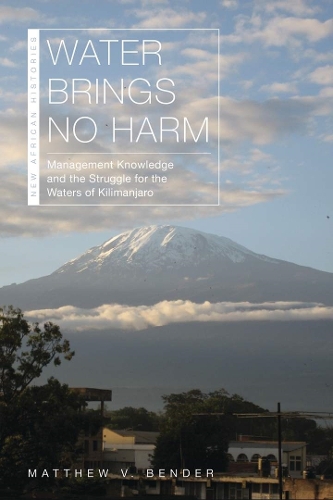
Water Brings No Harm explores the history of community water management on Mount Kilimanjaro. Using the concept of waterscapes—describing how people “see” water and how physical resources intersect with beliefs, needs, and expectations—Bender argues that water conflicts should be understood as struggles between competing forms of knowledge.
In Water Brings No Harm, Matthew V. Bender explores the history of community water management on Mount Kilimanjaro in Tanzania. Kilimanjaro’s Chagga-speaking peoples have long managed water by employing diverse knowledge: hydrological, technological, social, cultural, and political. Since the 1850s, they have encountered groups from beyond the mountain—colonial officials, missionaries, settlers, the independent Tanzanian state, development agencies, and climate scientists—who have understood water differently. Drawing on the concept of waterscapes—a term that describes how people “see” water, and how physical water resources intersect with their own beliefs, needs, and expectations—Bender argues that water conflicts should be understood as struggles between competing forms of knowledge.
Water Brings No Harm encourages readers to think about the origins and interpretation of knowledge and development in Africa and the global south. It also speaks to the current global water crisis, proposing a new model for approaching sustainable water development worldwide.
"“A pleasure to read, thanks to its straightforward, uncluttered prose and strong thematic continuity.”" - International Journal of African Historical Studies
"“Bender’s careful and detailed history of Kilimanjaro’s waterscapes makes a significant contribution to African environmental history.”" - African Studies Review