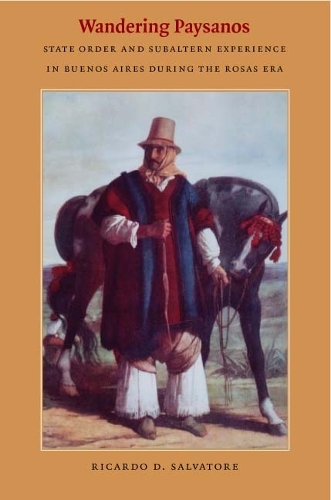
Книга Wandering Paysanos: State Order and Subaltern Experience in Buenos Aires during the Rosas Era
Provides a radically new interpretation of postcolonial Argentinian history, showing how marginalized groups used the resources of the market and state to avoid economic exploitation and government domination
A pioneering examination of the experiences of peasants and peons, or paysanos, in the Buenos Aires province during Juan Manuel de Rosas’s regime (1829–1852), Wandering Paysanos is one of the first studies to consider Argentina’s history from a subalternist perspective. The distinguished Argentine historian Ricardo D. Salvatore situates the paysanos as mobile job seekers within an expanding, competitive economy as he highlights the points of contention between the peasants and the state: questions of military service, patriotism, crime, and punishment. He argues that only through a reconstruction of the different subjectivities of paysanos—as workers, citizens, soldiers, and family members—can a new understanding of postindependence Argentina be achieved.
Drawing extensively on judicial and military records, Salvatore reveals the state’s files on individual prisoners and recruits to be surprisingly full of personal stories directly solicited from paysanos. While consistently attentive to the fragmented and mediated nature of these archival sources, he chronicles how peons and peasants spoke to power figures—judges, police officers, and military chiefs—about issues central to their lives and to the emerging nation. They described their families and their wanderings across the countryside in search of salaried work, memories and impressions of the civil wars, and involvement with the Federalist armies. Their lamentations about unpaid labor, disrespectful government officials, the meaning of poverty, and the dignity of work provide vital insights into the contested nature of the formation of the Argentine Confederation. Wandering Paysanos discloses a complex world until now obscured—that of rural Argentine subalterns confronting the state.
"Wandering Paysanos is an outstanding contribution to both the history of the first half of the nineteenth-century in Argentina and the recuperation of subaltern voices in Latin American studies."
- Hispanic American Historical Review
"Impressive. . . . Salvatore's analysis is rich and nuanced." - Crime, History and Societies
"Masterful. . . . The book contains much of interest to scholars, graduate students, and advanced undergraduates specializing in peasant studies, comparative development in Latin America, Latin American history, and penal and military history. . . . Vivid and absorbing. . . . This is social history at its best." - American Journal of Sociology
"This book represents an enormous contribution . . . to the political and social history of rural populations of nineteenth-century Latin America." - The Americas