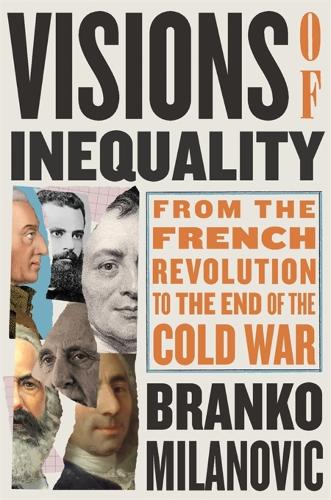
Книга Visions of Inequality: From the French Revolution to the End of the Cold War
A Financial Times Best Book of the Year.
A sweeping and original history of how economists across two centuries have thought about inequality, told through portraits of six key figures.
“How do you see income distribution in your time, and how and why do you expect it to change?” That is the question Branko Milanovic imagines posing to six of history's most influential economists: François Quesnay, Adam Smith, David Ricardo, Karl Marx, Vilfredo Pareto, and Simon Kuznets. Probing their works in the context of their lives, he charts the evolution of thinking about inequality, showing just how much views have varied among ages and societies. Indeed, Milanovic argues, we cannot speak of “inequality” as a general concept: any analysis of it is inextricably linked to a particular time and place.
Visions of Inequality takes us from Quesnay and the physiocrats, for whom social classes were prescribed by law, through the classic nineteenth-century treatises of Smith, Ricardo, and Marx, who saw class as a purely economic category driven by means of production. It shows how Pareto reconceived class as a matter of elites versus the rest of the population, while Kuznets saw inequality arising from the urban-rural divide. And it explains why inequality studies were eclipsed during the Cold War, before their remarkable resurgence as a central preoccupation in economics today.
Meticulously extracting each author’s view of income distribution from their often voluminous writings, Milanovic offers an invaluable genealogy of the discourse surrounding inequality. These intellectual portraits are infused not only with a deep understanding of economic theory but also with psychological nuance, reconstructing each thinker’s outlook given what was knowable to them within their historical contexts and methodologies.
"A timely book that brings the weight of the past to bear on one of the most pressing issues of our time…Milanovic is a clear and direct writer, unafraid of making strong judgements and with an idiosyncratic eye for detail. That makes for original, and sometimes amusingly wry, revelations." - Literary Review
"Inequality is back, as a political topic and as a focus of study. In this fascinating book, Milanovic, one of the world’s most influential scholars of inequality, examines what leading economists of the past have had to say on this issue." - Financial Times
"A history of the changing ways economists have broached the subject [of inequality] since the French Revolution…[Milanovic] describes how Western economists were in thrall to an unholy combination of extremely simplistic assumptions and extremely complex mathematical models." - New York Times
"A work of art in today’s economics. With equal intensity, the book traverses contemporary ideological, political, and social divides and implores theoretical and empirical economists to critically assess their intellectual positions…an essential and insightful analysis of the history of economic inequality urgently relevant today…a groundbreaking work, bound to influence the economics profession and our worldview." - LSE Review of Books
"An in-depth contextual analysis of how economic minds from Adam Smith to Karl Marx have shaped our understanding of class, income and wealth…This is a vital reference for the economic and philosophical theories underpinning our understanding of inequality today." - Financial Times
"An absorbing account of how thinking about inequality has evolved…Milanovic mixes his methodical examination of the evolution of economic thought about inequality with fascinating portraits of great economists and the society and polity of their times." - Finance & Development
"For anybody interested in inequality—and we all should be—anything by Milanovic is an essential read…This book is a great scene setter for the modern debate, not least in illustrating the link between ideas of inequality and the times in which ideas are formed." - Enlightened Economist
"'To remind us of the half-forgotten ways in which class can be integrated into the big economic picture, Milanovic takes us on a guided tour of six minds, spanning 200 years. The chapters blend tight analysis of how each thinker understood the forces reshaping inequality in their day with gobbets of gossip…[The author’s] judgments…are arrestingly fresh." - Prospect Magazine
"Steps back to question the study of inequality itself. Where does this work come from? Was inequality always so central a preoccupation for economists — or in politics at large? Ultimately, the book reveals the limits of a purely economic framing of these questions…a breezy tour d’horizon of economic conceptions of inequality since the Enlightenment." - Dissent
"A captivating journey through the time of ideas, with an impact on current events." - Les Echoes
"By…exploring the different ways inequality has been conceptualized, [Milanovic] prompts us to consider the political ramifications of our restricted focus on inter-individual distribution." - Commonweal
"Fully respond[s] to the Nobel laureate Angus Deaton’s call for economists to return to ‘serving society’…By offering a compelling account of how a bunch of past economists discussed income distribution, [this book]…shows to what extent an historically contextualised analysis of inequality is relevant today." - History of Economic Thought and Policy
"A noted economist examines the thinking of six of his predecessors on how income is distributed and the conditions that favor or hinder the accumulation of wealth." - Kirkus Reviews
"[A] sweeping survey of more than 200 years of philosophical thought about inequality." - Publishers Weekly