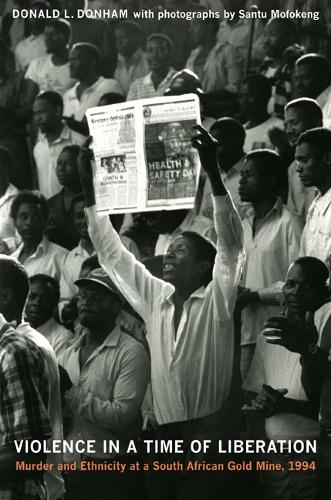
Книга Violence in a Time of Liberation: Murder and Ethnicity at a South African Gold Mine, 1994
Shows that heightened ethnic identity among black workers was more an outcome than a cause of two murders in a South African gold mine
How can we account for the apparent increase in ethnic violence across the globe? Donald L. Donham develops a methodology for understanding violence that shows why this question needs to be recast. He examines an incident that occurred at a South African gold mine at the moment of the 1994 elections that brought apartheid to a close. Black workers ganged up on the Zulus among them, killing two and injuring many more. While nearly everyone came to characterize the conflict as “ethnic,” Donham argues that heightened ethnic identity was more an outcome of the violence than its cause. Based on his careful reconstruction of events, he contends that the violence was not motivated by hatred of an ethnic other. It emerged, rather, in ironic ways, as capitalist managers gave up apartheid tactics and as black union activists took up strategies that departed from their stated values. National liberation, as it actually occurred, was gritty, contradictory, and incomplete. Given unusual access to the mine, Donham comes to this conclusion based on participant observation, review of extensive records, and interviews conducted over the course of a decade. Violence in a Time of Liberation is a kind of murder mystery that reveals not only who did it but also the ways that narratives of violence, taken up by various media, create ethnic violence after the fact.
"“A prescient narrative of mine violence. Based on a study of a mine called Cinderella, it provides a piercing and lucid exposition of the path to this violence in a post-1994 moment. . . . Violence in a Time of Liberation offers an exemplary example of how historical ethnography can be used to study violence. It probes us to give time and labour to understand better what has happened, even if its meanings remain elusive. For violence, too, is a way of remembering our disappointed hope.“" - Mail & Guardian
"“This is a beautifully produced book…. It is also beautifully written, thoughtful, intelligent, meticulous in making arguments, and humble in making its case and in acknowledgement of others’ work. For those who are interested in debates about the often violent ambiguities of “liberation” (in South Africa and elsewhere), this is a must read. It is also a masterpiece of anthropological narrative in its own right. Like any engaging detective story, it will be widely read.”" - Anthropos
"“This is a carefully analyzed, clearly written, and beautifully produced book. Donham’s careful attention to detail is nicely enhanced by South African photographer Santu Mofokeng’s work ....[It] is an important book with implications for analysis of many conflicts in the world that are all too easily dismissed as ethnic or religious. Donham leads us to see that these labels are not completely wrong but that they fail to incorporate the multiple dimensions in which the conflicts are embedded.”" - International Journal of African Historical Studies
"“What is particularly enjoyable about this book is the way in which Donham brings together multiple scales of analysis and discourses to demonstrate how ethnicity came to legitimate violence in the moment and explain the murders in retrospect…In sum, Donham’s monograph is an excellent example of ethnographic work on ethnicity that would provide excellent fodder for courses on nationalism, ethnicity, ethnic violence, and South Africa.”" - Journal of Anthropological Research
"“Working with an award-winning photographer Santu Mofokeng, Donham was able to capture in both word and image the grittiness and hardships of compound life. In truth, the use of image and text is powerful. . . . This book represents a kind of “reckoning” with a world in transition, with violence, with capitalism that surely extends far beyond South African studies to entice readers concerned with such questions almost anywhere.”" - American Ethnologist