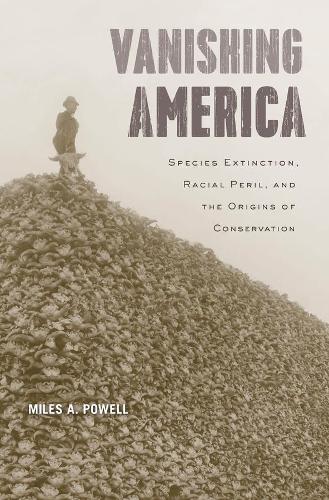
Книга Vanishing America: Species Extinction, Racial Peril, and the Origins of Conservation
Putting a provocative new slant on the history of U.S. conservation, Vanishing America reveals how wilderness preservation efforts became entangled with racial anxieties—specifically the fear that forces of modern civilization, unless checked, would sap white America’s vigor and stamina.
Nineteenth-century citizens of European descent widely believed that Native Americans would eventually vanish from the continent. Indian society was thought to be tied to the wilderness, and the manifest destiny of U.S. westward expansion, coupled with industry’s ever-growing hunger for natural resources, presaged the disappearance of Indian peoples. Yet, as the frontier drew to a close, some naturalists chronicling the loss of animal and plant populations began to worry that white Americans might soon share the Indians’ presumed fate.
Miles Powell explores how early conservationists such as George Perkins Marsh, William Temple Hornaday, and Aldo Leopold became convinced that the continued vitality of America’s “Nordic” and “Anglo-Saxon” races depended on preserving the wilderness. Fears over the destiny of white Americans drove some conservationists to embrace scientific racism, eugenics, and restrictive immigration laws. Although these activists laid the groundwork for the modern environmental movement and its many successes, the consequences of their racial anxieties persist.
"Powell’s intention is to illuminate a little-known chapter of American history, a lengthy period when wilderness was a racially charged concept… As the turn of the 20th century approached, many white people (most often identifying as Nordic or Anglo-Saxon) ‘saw themselves as an imperiled race,’ Powell writes, and perceived that their own impending extinction was reflected in the nation’s disappearing wildlife. Their solution for preserving both was to bar the wrong—i.e., non-Nordic or Anglo-Saxon white—people from wild lands… This exclusionary principle ended up forming the backbone of the conservation movement… Powell incorporates several forgotten sidebars to official environmental history in his book, many alarming but often also illuminating… The book deserves to be included in current discussions of class, race, and gender. It indicates how highly intelligent and educated, even often well-intentioned, individuals can band together to promote divisive and discriminatory causes. The book also reminds readers that the conceptualization of ‘us’ and ‘them’ in America history is not strictly placed along color lines, but is strongly tied with ideas of fitness and value—some of which sprang from essentially neutral (‘harmless’) scientific principles." - Pacific Standard
"Environmental historian Miles Powell has provided a new and provocative angle to the history of the American conservation/preservation movement through the lens of its racial logics." - New York Journal of Books