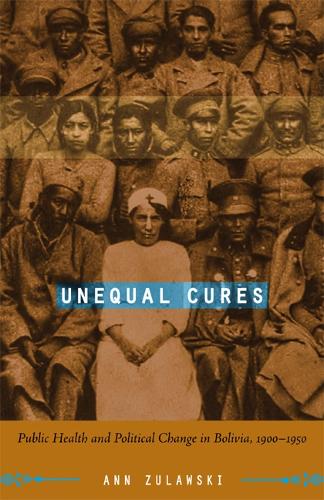
Книга Unequal Cures: Public Health and Political Change in Bolivia, 1900–1950
First systematic medical history of Bolivia for the 20th century, viewing political change from the perspective of public health
Unequal Cures illuminates the connections between public health and political change in Bolivia from the beginning of the twentieth century, when the country was a political oligarchy, until the eve of the 1952 national revolution that ushered in universal suffrage, agrarian reform, and the nationalization of Bolivia’s tin mines. Ann Zulawski examines both how the period’s major ideological and social transformations changed medical thinking and how ideas of public health figured in debates about what kind of country Bolivia should become. Zulawski argues that the emerging populist politics of the 1930s and 1940s helped consolidate Bolivia’s medical profession and that improved public health was essential to the creation of a modern state. Yet she finds that at mid-century, women, indigenous Bolivians, and the poor were still considered inferior and consequently received often inadequate medical treatment and lower levels of medical care.
Drawing on hospital and cemetery records, censuses, diagnoses, newspaper accounts, and interviews, Zulawski describes the major medical problems that Bolivia faced during the first half of the twentieth century, their social and economic causes, and efforts at their amelioration. Her analysis encompasses the Rockefeller Foundation’s campaign against yellow fever, the almost total collapse of Bolivia’s health care system during the disastrous Chaco War with Paraguay (1932–35), an assessment of women’s health in light of their socioeconomic realities, and a look at Manicomio Pacheco, the national mental hospital.
"“Unequal Cures is a well-written and thoroughly researched historical analysis of health care that neatly weaves together issues of gender, ethnicity, international health care, and medical access in Bolivia from 1900 to 1950. There is very little historical research on medicine or public health in Bolivia, and therefore Zulawski’s book is a welcome addition to the literature.”" - Journal of World History
"“Ann Zulawski’s study of health and the distribution of medical care in Bolivia in the first half of the twentieth century provides an insightful and subtly drawn account. It is a welcome addition to, and one of the finer examples of, a growing literature on health and medicine in Latin American history.”" - The Americas
"“This is a significant contribution to the field of Andean historiography, as well as to broader studies of gender, ethnicity, health and politics. . . . [T]he book’s originality rests in the way it links conflicts and policies pertaining to the establishment of a public health program in a small, poor country during the first half of the twentieth century to the larger context of gender, ethnic, and political history.”" - American Historical Review
"“Zulawski has written one of the most comprehensive histories of public health on a country often deemed, even by foreigners, of little importance to the region. Her book will help to transform this misperception. [E]ssential reading for anyone interested in the history of medicine or public health in the developing world and specifically in Latin America.”" - Bulletin of the Pacific Circle