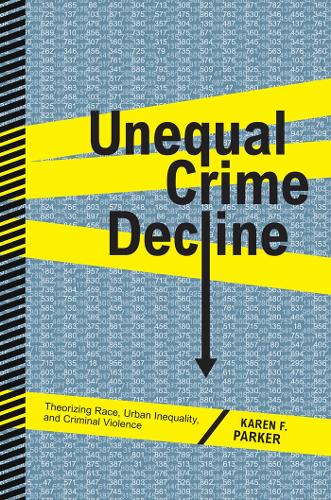
Книга Unequal Crime Decline: Theorizing Race, Urban Inequality, and Criminal Violence
A structural and theoretical analysis of the various factors that affect the crime decline.
2009 Choice Outstanding Academic Title
Crime in most urban areas has been falling since 1991. While the decline has been well-documented, few scholars have analyzed which groups have most benefited from the crime decline and which are still on the frontlines of violence—and why that might be. In Unequal Crime Decline, Karen F. Parker presents a structural and theoretical analysis of the various factors that affect the crime decline, looking particularly at the past three decades and the shifts that have taken place, and offers original insight into which trends have declined and why.
Taking into account such indicators as employment, labor market opportunities, skill levels, housing, changes in racial composition, family structure, and drug trafficking, Parker provides statistics that illustrate how these factors do or do not affect urban violence, and carefully considers these factors in relation to various crime trends, such as rates involving blacks, whites, but also trends among black males, white females, as well as others. Throughout the book she discusses popular structural theories of crime and their limitations, in the end concentrating on today’s issues and important contemporary policy to be considered. Unequal Crime Decline is a comprehensive and theoretically sophisticated look at the relationship among race, urban inequality, and violence in the years leading up to and following America’s landmark crime drop.
"Essential." - Choice
"All of this can be summarized in the following three reasons that Parkers book is important: she begins with a question that deserves an answer, she demonstrates how that question is far more complex than most have thought, and she offers an answer that is theoretically rich." - Contemporary Sociology
"Her analysis is not only a thorough review of the debate on the link between violent crime and unemployment; it is an exploration into the complex intertwining between ethnicity, gender, population composition and political economy in violent crime . . . a hugely rewarding read." - British Journal of Criminology
"Parkers theoretical integration is so straightforward and intuitive that it makes one wonder why it took so long for sociologists to consider such an amalgamation. Sociologists interested in the urban economy should seriously consider the ways in which labor market changes stratify racial groups along dimensions of crime and violence. Meanwhile, criminologists would do well to heed Parkers call for a richer and more dynamic theoretical treatment of the economy in their models of changing crime rates." - American Journal of Sociology
"Parker's book is an important addition to our understanding of the crime drop of the 1990s. In fact, her research sheds new light on this important social trend, dispels myths that continue to surround it, and demonstrates how criminology theory has not been particularly relevant to our understanding of how and why it occured." - Journal of American Ethnic History
"The absence of obfuscation is exemplary and this unpretentious text is student-friendly as well as useful for all postgraduate students, academics and policy-makers who wish to furnish themselves with a clear, empirically grounded and sophisticated picture of the 'crime drop'" - Urban Studies Journal