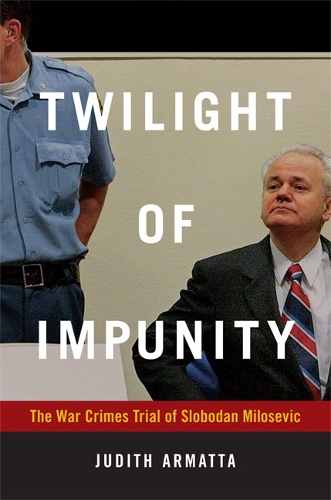
Книга Twilight of Impunity: The War Crimes Trial of Slobodan Milosevic
The definitive account of the trial of Slobodan Milosevic for war crimes, crimes against humanity and genocide, written by a journalist and human-rights attorney
An eyewitness account of the first major international war-crimes tribunal since the Nuremberg trials, Twilight of Impunity is a gripping guide to the prosecution of Slobodan Milosevic for war crimes, crimes against humanity, and genocide. The historic trial of the “Butcher of the Balkans” began in 2002 and ended abruptly with Milosevic’s death in 2006. Judith Armatta, a lawyer who spent three years in the former Yugoslavia during Milosevic’s reign, had a front-row seat at the trial. In Twilight of Impunity she brings the dramatic proceedings to life, explains complex legal issues, and assesses the trial’s implications for victims of the conflicts in the Balkans during the 1990s and international justice more broadly. Armatta acknowledges the trial’s flaws, particularly Milosevic’s grandstanding and attacks on the institutional legitimacy of the International Criminal Tribunal. Yet she argues that the trial provided an indispensable legal and historical narrative of events in the former Yugoslavia and a valuable forum where victims could tell their stories and seek justice. It addressed crucial legal issues, such as the responsibility of commanders for crimes committed by subordinates, and helped to create a framework for conceptualizing and organizing other large-scale international criminal tribunals. The prosecution of Slobodan Milosevic in The Hague was an important step toward ending impunity for leaders who perpetrate egregious crimes against humanity.
"“[An] amazing book. . . . Armatta . . . has brought a boots-on-the-ground understanding of the Balkans from previous work in Serbia, Montenegro, and Macedonia. In her observations, she proves to be an acute student of law, character, strategy, and history. . . . [T]his is a wonderful and important book. Armatta has captured not only the sights and sounds of the court, but also of the Balkans itself, and the book emerges analyzing the biggest themes of international justice. It has enormous implications for the future. . . . Every practitioner and student of international relations should read Armatta’s book.”" - Washington Monthly
"“[Armatta’s] is the front-row view of a first-rate court reporter, giving the reader a TiVo-like version, culled of dead space and repetition, that is still exhausting in its arduous pace and detail. Diligently, she watched and recorded as the court probed all three charges from Kosovo, back through the Croatian and Bosnian wars, tediously piling up the evidence as Milosevic bobbed and weaved. One comes away half heartened by the effort to answer unspeakable cruelty and suffering with justice but, in a way, more saddened by Milosevic's slippery success in persuading his partisans and many of his countrymen that they, not he, were on trial, the victims of great power bullies.“" - Foreign Affairs
"“Armatta’s encyclopedic compendium is impeccably researched, meticulous, detailed, prudent, and careful. It distinguishes itself as a must-read.”" - Law and Politics Book Review
"Will Armatta’s book, or others like it, get us any closer to achieving what is arguably the most valuable and probably the most realisable objective of these courts, which would be to lay out a record of evidence that could be used to justify earlier and more decisive political and military action in future conflicts with a similar potential for war crimes? We can hope so." - London Review of Books