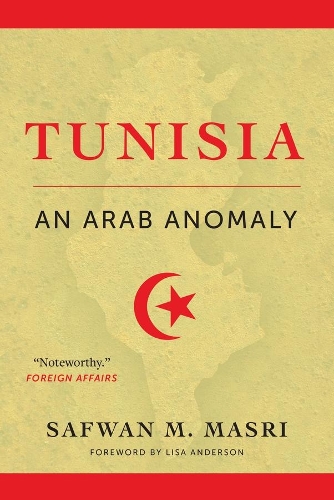
The Arab Spring began and ended with Tunisia. In a region beset by brutal repression, humanitarian disasters, and civil war, Tunisia's Jasmine Revolution alone gave way to a peaceful transition to a functioning democracy. Within four short years, Tunisians passed a progressive constitution, held fair parliamentary elections, and ushered in the country's first-ever democratically elected president. But did Tunisia simply avoid the misfortunes that befell its neighbors, or were there particular features that set the country apart and made it a special case?
In Tunisia: An Arab Anomaly, Safwan M. Masri explores the factors that have shaped the country's exceptional experience. He traces Tunisia's history of reform in the realms of education, religion, and women's rights, arguing that the seeds for today's relatively liberal and democratic society were planted as far back as the middle of the nineteenth century. Masri argues that Tunisia stands out not as a model that can be replicated in other Arab countries, but rather as an anomaly, as its history of reformism set it on a separate trajectory from the rest of the region. The narrative explores notions of identity, the relationship between Islam and society, and the hegemonic role of religion in shaping educational, social, and political agendas across the Arab region. Based on interviews with dozens of experts, leaders, activists, and ordinary citizens, and a synthesis of a rich body of knowledge, Masri provides a sensitive, often personal, account that is critical for understanding not only Tunisia but also the broader Arab world.
"Masri...has done Arabs an enormous service by highlighting the catastrophic state of their education systems - despotic and as intellectually sterile as the political systems that engendered them." - Financial Times
"Masri presents a stimulating account of Tunisia’s democratic transition that deserves to be read widely in the Arab world as well by students of the Middle East and policy makers. Highly recommended." - Choice
"Tunisia at least offers some guidance as to how political actors elsewhere in the region might negotiate their own paths away from authoritarianism and how the challenges they confront could yet be overcome." - LSE Blog
"Safwan Masri’s book is a very welcome explanation of why Tunisia has a reasonable chance of growing deeper democratic roots." - Arab Digest Newsletter
"Masri's book offers a holistic account of the story of Tunisia through the ages." - Al Ahram
"Masri does an excellent job of examining the historical factors that make Tunisia what it is." - Arab Weekly
"Masri does an excellent job of showing that the success of Tunisia's Jasmine revolution has deep roots in history." - Development and Cooperation
"Masri does an excellent job of showing that the success of Tunisia's Jasmine revolution has deep roots." - Qantara
"Engaging and well-written." - Reading Religion
"Highly readable." - Weekly Standard
"Noteworthy." - Foreign Affairs
"A deeply learned, sensitive, and searching book. . . . Tunisia: An Arab Anomaly is an essential document for those who wish to understand the Arab Spring’s lone (if tentative) democratic victory." - Journal of Democracy
"The most important recent work on the topic.... the volume is gracefully free of jargon and the narrative flows freely and is well structured. The book shines in its easy storytelling fluency and therefore in its appeal to nonspecialists." - Journal of Global South Studies
"Tunisia: An Arab Anomaly is a valuable addition to the plethora of scholarship about the Arab world, a must read for scholars, students, and the average reader who seek knowledge about the region." - Arab Studies Quarterly