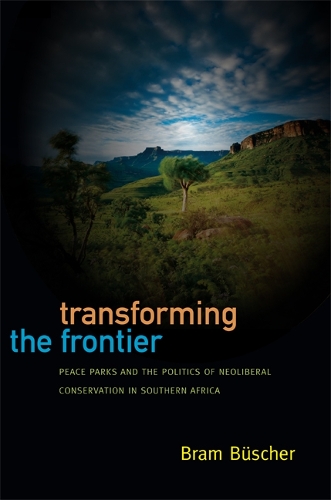
Книга Transforming the Frontier: Peace Parks and the Politics of Neoliberal Conservation in Southern Africa
In Transforming the Frontier, Bram Buscher shows how cross-border conservation neatly reflects the neoliberal political economy in which it developed.
International peace parks—transnational conservation areas established and managed by two or more countries—have become a popular way of protecting biodiversity while promoting international cooperation and regional development. In Transforming the Frontier, Bram Büscher shows how cross-border conservation neatly reflects the neoliberal political economy in which it developed.
Based on extensive research in southern Africa with the Maloti-Drakensberg Transfrontier Conservation and Development Project, Büscher explains how the successful promotion of transfrontier conservation as a "win-win" solution happens not only in spite of troubling contradictions and problems, but indeed because of them. This is what he refers to as the "politics of neoliberal conservation," which receives its strength from effectively combining strategies of consensus, antipolitics, and marketing. Drawing on long-term, multilevel ethnographic research, Büscher argues that transfrontier conservation projects are not as concerned with on-the-ground development as they are purported to be. Instead, they are reframing environmental protection and sustainable development to fit an increasingly contradictory world order.
"“Like a skilled jurist, Bram Büscher pieces together a compelling argument about the corrupting influences of neoliberalism in environmental policy by using the Maloti-Drakensberg Transfrontier Conservation and Development Project as a case study…. Using an ethnographic approach that combines political ecology with international relations to delve into these elements, Büscher makes insightful arguments to show how governance structure emerges and why it evolves as it does. At its best, the book uses this to contrast community-based natural resource management with bioregional conservation planning.”" - Global Governance
"“Transforming the Frontier is a concise book-length analysis of one particular transboundary conservation initiative. It expertly combines extensive theoretical discussion with the results of in-depth . . . field work. At the same time, it demonstrates how the MDTP is illustrative of a wider trend in contemporary conservation discourse and practice. Büscher’s efforts to link MDTP dynamics to the regional and global neoliberal political economy are convincing.”" - Mountain Research and Development
"“Transforming the Frontier is a sophisticated, theoretically heavy text, one that provokes the reader to seriously reflect on the effect of the increasingly common neoliberal governance of conservation. It is well worth the read.”" - Conservation Biology
"[A] masterful piece of scholarship that should find a hallowed place on our bookshelves . . ." - Review of Policy Research
" . . . [Buscher's] approach immerses the reader in cutting edge academic thinking on conservation in the modern world . . . and gives the reader an idea of what tools are needed to conceptualise and analyse complex governmental systems in action . . . Buscher's book will surely help on the road to greater understanding." - International Journal of Environmental Studies
"Transforming the Frontier offers a rich political ecology and a fascinating look not only at how the real and material are both discursive and nondiscursive categories but Büscher also clearly points to how these lines are blurring as conservation and development delve further and further into neoliberal arenas." - PoLAR