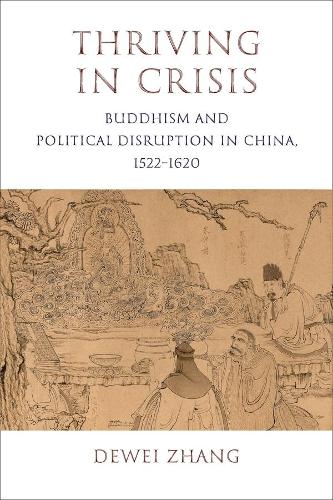
Книга Thriving in Crisis: Buddhism and Political Disruption in China, 1522–1620
Late imperial Chinese Buddhism was long dismissed as having declined from the glories of Buddhism during the Sui and Tang dynasties (581–907). In recent scholarship, a more nuanced picture of late Ming-era Buddhist renewal has emerged. Yet this alternate conception of the history of Buddhism in China has tended to focus on either doctrinal contributions of individual masters or the roles of local elites in Jiangnan, leaving unsolved broader questions regarding the dynamics and mechanism behind the evolution of Buddhism into the renewal.
Thriving in Crisis is a systematic study of the late Ming Buddhist renewal with a focus on the religious and political factors that enabled it to happen. Dewei Zhang explores the history of the boom in enthusiasm for Buddhism in the Jiajing-Wanli era (1522–1620), tracing a pattern of advances and retrenchment at different social levels in varied regions. He reveals that the Buddhist renewal was a dynamic movement that engaged a wide swath of elites, from emperors and empress dowagers to eunuchs and scholar-officials. Drawing on a range of evidence and approaches, Zhang contends that the late Ming renewal was a politically driven exception to a longer-term current of disfavor toward Buddhism and that it failed to establish Buddhism on a foundation solid enough for its future development. A groundbreaking interdisciplinary study, Thriving in Crisis provides a new theoretical framework for understanding the patterns of Buddhist history in China.
"This book is a superior monograph that provides an updated and comprehensive foundation for contextualizing the weaknesses to which Buddhism became vulnerable during the Ming, which lasted well into the Qing dynasty." - Buddhist Door
"A very useful and thought-provoking study in the history of Chinese Buddhism and its place in traditional society in general. It can be recommended not only to specialist readers, but also general readers, especially students of Chinese history, religion, and culture." - Studies in Chinese Religions
"The book is a welcome addition to the growing list of monographs that address Ming-Qing Buddhism. It charts new paths for
scholars interested in similar topics and would be of interest to scholars in the fields of Buddhist studies, Chinese religion, and Ming-Qing history, among others." - Hualin International Journal of Buddhist Studies
"This book makes a major contribution to our understanding of the late Ming Buddhist renewal. The author combines rigorous statistical analysis with an engaging in-depth historical narrative. These approaches are further enhanced by his skillful use of rich and varied original sources. This book will become indispensable for students of Ming Buddhism." - H-Buddhism
"Well-written, clearly argued, persuasive book." - Choice
"Zhang Dewei is a rare and welcome example of someone who can handily
discuss both politics, power, court intrigue, and history on one hand and the
world of Buddhism and religious culture on the other. Readers interested in
either of these sides of the coin during this critical period of the Ming would
find much of value in this book, and it is a welcome contribution to this developing field." - Monumenta Serica
"This volume will, without a doubt, prove to be essential reading for everyone interested in Míng period Buddhism. . . . Not only does Zhang successfully paint a rich picture of Míng-era Buddhism and politics, the sheer scope of this ambitious volume will hopefully generate fruitful further study and dialog." - Religious Studies Review