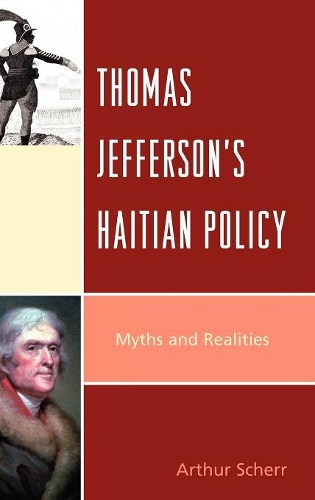
Книга Thomas Jefferson's Haitian Policy: Myths and Realities
Among the most controversial aspects of Thomas Jefferson's presidency, indeed of his political career, is his policy toward the country that is now Haiti, then known as St. Domingo. While eschewing substantial research on his Haitian policies, most historians condemn Jefferson as a racist who implemented his anti-African American agenda by plotting with Napoleon to "starve Toussaint," Touissaint Louverture, Haiti's ruler, into submission to the French armies. When the strategy failed, and Haiti became independent in 1804, Jefferson allegedly exerted his efforts to force Congress to impose an embargo on Haiti from 1806–1809. This is the orthodox, mainstream interpretations of Jefferson's Haitian policies today. In a revolutionary revisionist reassessment, Arthur Scherr's Thomas Jefferson's Haitian Policy: Myths and Realities challenges and undermines this interpretation. His extensively researched work reveals that Jefferson was in fact generally favorable to the Haitian Revolution, before and during his presidency, and supportive of its independence. Moreover, during his retirement from the presidency, when no longer burdened with the responsibilities of national consensus-seeking in public office, he went so far as to propose the newborn slaves in the southern United States be emancipated once they reached puberty and sent to Haiti, a scheme which would strengthen the unique, black-ruled West Indian country and gradually eliminate the repulsive powder keg of Southern slavery from US shores.
"Scherr's interpretation is intriguing, . . . compelling, and a useful counter to recent scholarship. . . .When studying a figure as complex as Thomas Jefferson, each new volume adds a bit to the puzzle. Scherr has made a contribution and a helpful correction." - Journal of American History
"[The author] brings work in Haitian history into conversation with the history of the early American republic and its troubled relationship with France. Much of the value of this book lies in its meticulous scholarship. In his close reading of his sources—namely letters, diplomatic documents and periodicals—he has done some intricate detective work, not just in terms of Franco– American–Haitian relations, but in terms of what evidence exists that suggests the options and motives of key players such as Jefferson and Madison in both diplomacy and domestic politics. Thus, the book also reflects how closely intertwined the foreign and the domestic were." - Journal of the Early Republic
"Scherr’s well-researched and well-written monograph should appeal to US and Latin American scholars as well as graduate students interested in knowing more about Thomas Jefferson’s views on slavery and Haiti." - The International History Review