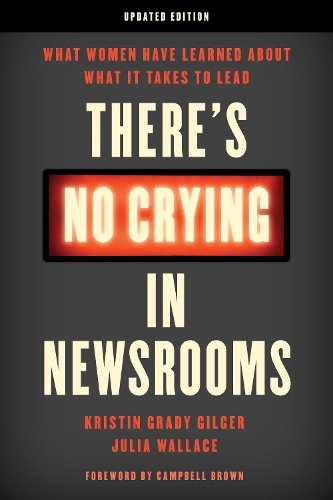
Книга There's No Crying in Newsrooms: What Women Have Learned about What It Takes to Lead
There’s No Crying in Newsrooms tells the stories of remarkable women who broke through barrier after barrier at media organizations around the country over the past four decades. They started out as editorial assistants, fact checkers and news secretaries and ended up running multi-million-dollar news operations that determine a large part of what Americans read, view and think about the world. These women, who were calling in news stories while in labor and parking babies under their desks, never imagined that 40 years later young women entering the news business would face many of the same battles they did – only with far less willingness to put up and shut up.
The female pioneers featured in this book have many lessons to teach about what it takes to succeed in media or any other male-dominated organization, and their message is more important now than ever before. Including stories and data from 2020—a year of unprecedented turmoil from a worldwide pandemic, rampant social upheaval, and divisive political battles—the updated edition of this chronicle of courage serves as both inspiration and impetus to continue the fight for equity and advancement in the media industry.
"Riffing off Tom Hanks’ line in A League of Their Own, "There's no crying in baseball," for their title, veteran journalists, editors, and educators Gilger and Wallace cogently demonstrate why the admonition is equally apt in newsrooms. Journalism is a field in which men have always dominated, and any woman who wanted to compete needed to demonstrate that she wouldn’t fall victim to her gender’s stereotypical emotional fragility. It wouldn’t be easy. Sexism and sexual harassment were rampant. Expectations for women were not only doubled, they were quadrupled. Hypocrisy reigned in story assignments, travel arrangements, job promotions, and, of course, salary equity. The authors interviewed nearly 100 women media leaders, from CNN’s Christiane Amanpour to Vox ’s Melissa Bell, to assess the changing image of women in journalism, how they achieved success, and what they envision as the industry’s future. The result is a commanding critique of the current state of women in media, boosted by constructive advice applicable to workplaces other than newsrooms. A crucial resource for women leaders in any field." - Booklist
"Gilger and Wallace (both, Arizona State) profile some successful female journalists and provide pragmatic advice to women within (and entering) the news media. Most of the book’s nine chapters are interspersed with career tips, which are partially derived from accompanying profiles and vignettes. The examples are contemporary and focus on the career challenges of women journalists within diverse mass media platforms, including digital, newspapers, magazines, radio, and television. Among the array of interesting profiles, the book describes the challenging 32-month tenure of Jill Abramson as the executive editor of the New York Times. The latter adds insights to Ms. Abramson’s recent book, Merchants of Truth (2019). While Gilger and Wallace base their book on interviews of more than 100 journalists, they provide occasional context, such as a discussion about the increasing presence of women in journalism during the past four decades. The text is well written and contains a list of interviewees, chapter footnotes, and some cheerful photographs." - CHOICE
"Collecting the stories of women who have spent the last four decades in media, There's No Crying in Newsrooms is an essential read for any aspiring journalist or reporter." - Bustle
"Kristin Grady Gilger and Julia Wallace (both news veterans) ask the questions you’ve always wanted to know from the women at the top: “How did you get where you are?” “What did you say to the creepy guys at work?” “Do you think you made the right decision to (not) have kids?” and “What can I do today to get ahead?” . . . The authors weave the stories of dozens of women leaders into the broader history of gender and civil rights in America, and in how news and journalism are changing in the digital age." - Women2