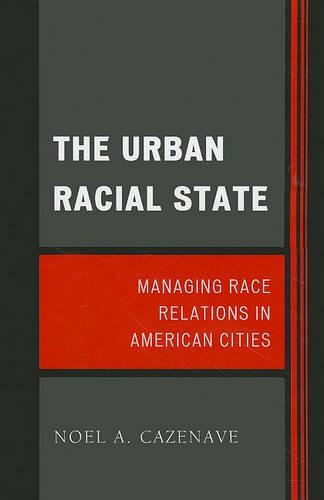
Книга The Urban Racial State: Managing Race Relations in American Cities
The Urban Racial State introduces a new multi-disciplinary analytical approach to urban racial politics that provides a bridging concept for urban theory, racism theory, and state theory. This perspective, dubbed by Noel A. Cazenave as the Urban Racial State, both names and explains the workings of the political structure whose chief function for cities and other urban governments is the regulation of race relations within their geopolitical boundaries. In The Urban Racial State, Cazenave incorporates extensive archival and oral history case study data to support the placement of racism analysis as the focal point of the formulation of urban theory and the study of urban politics. Cazenave's approach offers a set of analytical tools that is sophisticated enough to address topics like the persistence of the urban racial state under the rule of African Americans and other politicians of color.
"Sociologist Cazenave (Univ. of Connecticut) presents an analytical approach to studying urban racial politics. He posits that in US cities, an urban racial state (consisting of the municipal government and other key local institutions) attempts to manage race relations, with the ultimate goal of maintaining the racial status quo within a metropolitan area to the benefit of the dominant racial group, white Americans. The author provides case studies based on archival research in New Haven and Syracuse during the civil rights era of the 1950s-60s in support of his proposed theoretical approach to understanding race relations in US cities. This provocative volume provides an important contribution to the field of critical race theory. While much of the focus is upon theory construction, Cazenave also provides extensive histories of community action programs initiated in African American neighborhoods of northeastern US cities in the 1960s, which may interest broader audiences. Of strongest interest to students and scholars of US urban history, African American studies, and ethnic studies. Summing Up: Recommended. Upper-division undergraduates and above." - CHOICE