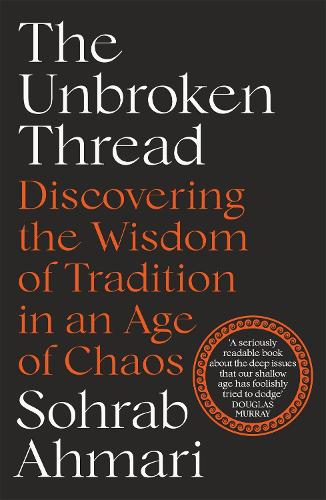
Книга The Unbroken Thread: Discovering the Wisdom of Tradition in an Age of Chaos
'A serious - and seriously readable - book about the deep issues that our shallow age has foolishly tried to dodge' - Douglas Murray
'A crystal-clear analysis of the multiple failures of "me-first" contemporary liberalism' - Giles Fraser
For millennia, philosophical, ethical and theological reflection was commonplace among the intellectually curious. But the wisdom that some of the greatest minds across the centuries continue to offer us remains routinely ignored in our modern pursuit of self-fulfilment, economic growth and technological advancement.
Sohrab Ahmari, the influential Op-Ed editor at the New York Post, offers a brilliant examination of our postmodern Western culture, and an analysis of the paradox at its heart: that the 'freedoms' we enjoy - to be or do whatever we want, subject only to consent, with everything morally neutral or relative - are at odds with the true freedom that comes from the pursuit of the collective good.
Rather than the insatiable drive to satisfy our individual appetites, this collective good involves self-sacrifice and self-control. It requires us to diminish so that others may grow. What responsibility do we have to our parents? Should we think for ourselves? Are sexual ethics purely a private matter? How do we justify our lives? These, and other questions - explored in the company of a surprising range of ancient and contemporary thinkers - reveal how some of the most ancient moral problems are as fresh and relevant to our age as they were to our ancestors.
By plumbing the depths of each question, the book underscores the poverty of our contemporary narratives around race, gender, privilege (and much else), exposing them as symptoms of a deep cultural crisis in which we claim a false superiority over the past, and helps us work our way back to tradition, to grasp at the thin, bare threads in our hands, while we still can.
"Thought provoking" - The Sunday Telegraph
"We cannot undo technological or material changes; the moving finger writes, and having writ, moves on, as the Persian poet Omar Khayyam said. What we can do is match well-written, thoughtful and true arguments like Ahmari's with serious thinking about how to make the material incentives match them." - Unherd
"Sohrab Ahmari's robust defence of inherited wisdom, rooted overwhelmingly if not exclusively in the Christian faith, may be interpreted as a scholarly rebuke to the fashionable currents of our rootless age." - The Times
"engaging and entertaining read" - The Critic
"Perhaps because Ahmari is writing for his son, there is an enthralling immediacy in the way he reads." - The Times
"
Bristling with ideas and insights, this is a book to engage theologians and general readers alike, as we seek deeper wisdom within which to situate contemporary questions and concerns.
" - The Church Times