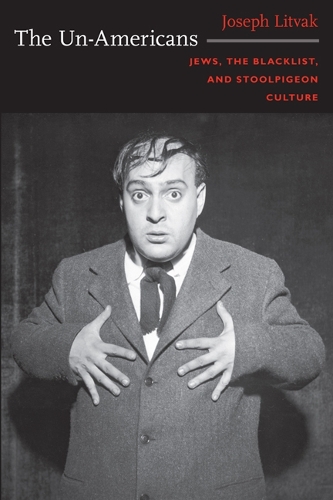
Книга The Un-Americans: Jews, the Blacklist, and Stoolpigeon Culture
How Jewish assimilation into American culture during the blacklist period was characterized by a demand to be a stoolpigeon, or to become an informer
In a bold rethinking of the Hollywood blacklist and McCarthyite America, Joseph Litvak reveals a political regime that did not end with the 1950s or even with the Cold War: a regime of compulsory sycophancy, in which the good citizen is an informer, ready to denounce anyone who will not play the part of the earnest, patriotic American. While many scholars have noted the anti-Semitism underlying the House Un-American Activities Committee’s (HUAC’s) anti-Communism, Litvak draws on the work of Theodor W. Adorno, Hannah Arendt, Alain Badiou, and Max Horkheimer to show how the committee conflated Jewishness with what he calls “comic cosmopolitanism,” an intolerably seductive happiness, centered in Hollywood and New York, in show business and intellectual circles. He maintains that HUAC took the comic irreverence of the “uncooperative” witnesses as a crime against an American identity based on self-repudiation and the willingness to “name names.” Litvak proposes that sycophancy was (and continues to be) the price exacted for assimilation into mainstream American culture, not just for Jews, but also for homosexuals, immigrants, and other groups deemed threatening to American rectitude.
Litvak traces the outlines of comic cosmopolitanism in a series of performances in film and theater and before HUAC, performances by Jewish artists and intellectuals such as Zero Mostel, Judy Holliday, and Abraham Polonsky. At the same time, through an uncompromising analysis of work by informers including Jerome Robbins, Elia Kazan, and Budd Schulberg, he explains the triumph of a stoolpigeon culture that still thrives in the America of the early twenty-first century.
"“[A] formidable piece of scholarship, one with which subsequent studies of the blacklist, the Hollywood social problem film and accounts of Jewish-American culture will most certainly have to contend.”" - Cineaste
"“[T]his book is an elegant, provocative, and at times brilliant contribution to both Jewish cultural studies and debates about the mix of popular art and politics in the blacklist era.”" - Theatre History Studies
"“In its focus on the broader political and cultural impact of Jewishness (as well as Jews) and in its refusal to get mired in the stasis of identity studies, Litvak’s book represents a new and welcome direction for both American Studies and Jewish Studies, especially as they relate to one another.”" - MELUS
"“Litvak says outright his is not yet another history. Instead, he gives us a craftily organized disorderly form, which I mean as a compliment. Despite its gravity regarding the individual and social harm caused by Cold War anti-Communism, The Un-Americans offers readers a festive scavenger hunt, streaked with Yiddishkeit (remnants of a time when Jews were still outsiders in the United States) and stocked with insight into the blacklist’s cloudy cultural terrain and legacies.”" - Jump Cut
"“This is a book which is a revelation in itself, and defines what it is to be free in an allegedly democratic society, where difference is damned and duty to nation comes before conscience and what is right. A triumph for Litvak and necessary reading for anyone who believes that the land of the free is alive and well.”" - M/C Reviews