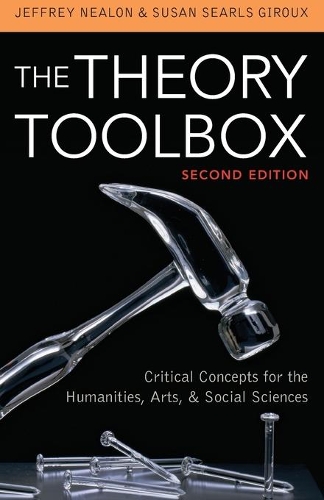
Книга The Theory Toolbox: Critical Concepts for the Humanities, Arts, & Social Sciences
This text involves students in understanding and using the "tools" of critical social and literary theory from the first day of class. It is an ideal first introduction before students encounter more difficult readings from critical and postmodern perspectives. Nealon and Searls Giroux describe key concepts and illuminate each with an engaging inquiry that asks students to consider deeper and deeper questions. Written in students' own idiom, and drawing its examples from the social world, literature, popular culture, and advertising, The Theory Toolbox offers students the language and opportunity to theorize rather than positioning them to respond to theory as a reified history of various schools of thought. Clear and engaging, it avoids facile description, inviting students to struggle with ideas and the world by virtue of the book's relentless challenge to common assumptions and its appeal to common sense. Updated throughout, the second edition of The Theory Toolbox includes a discussion of new media, as well as two new chapters on life and nature.
"As the title suggests, this work by Nealon and Giroux can be considered an assemblage of tools (or approaches) that students may use to examine contemporary culture. Unlike other introductions to theory, such as Terry Eagleton's Literary Theory (2nd ed., 1996), The Theory Toolbox is not organized by theoretical schools or movements but by concepts such as 'Reading,' 'History,' and 'Authority.' Each chapter introduces a concept, demonstrates how that concept can be used to analyze an instance of contemporary culture, and then ends with questions for readers to ponder. A bibliography with suggestions for further reading follows. The Theory Toolbox was first published in 2003, and many of the chapters in the second edition appear verbatim. New to this edition are sections such as 'Media Culture 2.0' and entire chapters titled 'Life' and 'Nature.' The added sections amount to 25 percent new material and merit a new edition. This book is geared toward lower-division undergraduates, and the tone, language, and examples reflect this focus. For example, YouTube, Facebook, and Black Sabbath are analyzed or questioned. Instructors using theory in their classroom teaching may find this book a useful means of introducing difficult concepts to first-year students in a manner they can understand. All undergraduates will find this a valuable companion for analyzing contemporary culture." - CHOICE