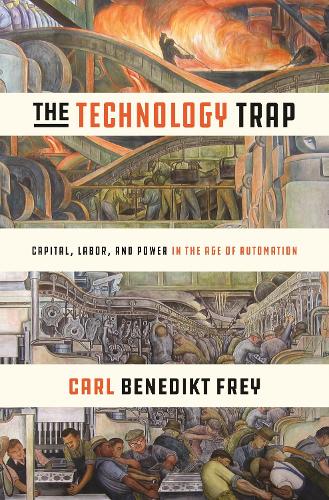
Книга The Technology Trap: Capital, Labor, and Power in the Age of Automation
"Made me look at the industrial revolution, invention, sleeping beauties, contexts and the forces that shape our societies differently."—David Byrne, New York Times Book Review
How the history of technological revolutions can help us better understand economic and political polarization in the age of automation
From the Industrial Revolution to the age of artificial intelligence, The Technology Trap takes a sweeping look at the history of technological progress and how it has radically shifted the distribution of economic and political power among society’s members. As Carl Benedikt Frey shows, the Industrial Revolution created unprecedented wealth and prosperity over the long run, but the immediate consequences of mechanization were devastating for large swaths of the population. Middle-income jobs withered, wages stagnated, the labor share of income fell, profits surged, and economic inequality skyrocketed. These trends, Frey documents, broadly mirror those in our current age of automation, which began with the Computer Revolution.
Just as the Industrial Revolution eventually brought about extraordinary benefits for society, artificial intelligence systems have the potential to do the same. But Frey argues that this depends on how the short term is managed. In the nineteenth century, workers violently expressed their concerns over machines taking their jobs. The Luddite uprisings joined a long wave of machinery riots that swept across Europe and China. Today’s despairing middle class has not resorted to physical force, but their frustration has led to rising populism and the increasing fragmentation of society. As middle-class jobs continue to come under pressure, there’s no assurance that positive attitudes to technology will persist.
The Industrial Revolution was a defining moment in history, but few grasped its enormous consequences at the time. The Technology Trap demonstrates that in the midst of another technological revolution, the lessons of the past can help us to more effectively face the present.
"The Technology Trap may well ensnare doom-seekers’ attention with its ominous-sounding title. But it should ultimately hearten anyone who reads it." - The Economist
"Narrator Richard Lyddon performs an almost impossible feat—making a very theoretical audiobook sound absorbable in a truly entertaining way . . . . Cheers to both Frey and Lyddon, a pairing that listeners may wish to hear again." - AudioFile Magazine
"[Frey] investigates the short, medium, and long-term consequences of the Industrial Revolution on workers, finding that in fact the changes had extraordinarily negative consequences in the short term. His lessons from this pivotal moment in history can help technology leaders avoid the biggest risks today in how we design human/AI systems in the coming age of automation." - TechCrunch
"A . . . danger is that Luddite efforts to avoid the short-term costs associated with a new technology will end up denying access to its long-term benefits—something Carl Benedikt Frey, an Oxford academic, calls a 'technology trap'." - The Economist
"A powerful historical synthesis on the question of the relationship between man and machine." - Wall Street Journal