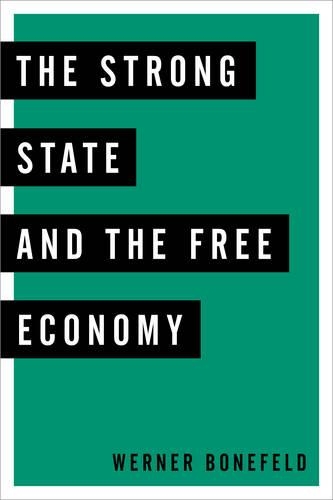
Книга The Strong State and the Free Economy
German ordoliberalism originated at the end of the Weimar Republic (1918-1933) in a context of hyper-inflation, depression, mass unemployment and social unrest. For ordoliberalism, a free economy is premised on a sound political, legal, social and moral framework to secure its cohesion. The role of the state is to ensure a liberal economic order. Ordoliberalism is a contested account of post-neoliberal political economy: some argue that it offers a more restrained and socially just market order; others, in complete contrast, that is a form of authoritarian liberalism and that it is the theoretical foundation for the austerity politics that the EU has actively promoted in recent years. Foucault discusses ordoliberalism at length in The Birth of Biopolitics, and Bonefeld’s book provides a thought-provoking companion to those lectures by offering a more comprehensive investigation of the theoretical foundation of ordoliberal thought and its historical and theoretical contexts.
"Werner Bonefeld … argues powerfully that neoliberalism is a political project grounded in a strong state. A free economy, he argues, is built through a state that protects itself from democratic interests and imposes an order of economic liberty on society. … Bonefeld’s historical reach and theoretical acumen clarify many obscure problems regarding neoliberalism and its development. His book is an important and timely analysis of the political form of neoliberalism, as well as a welcome contribution to the on-going crises of the present capitalist order." - Marx and Philosophy Review of Books
"At a time where discussion of the EU has degenerated into opposed normative judgements regarding its desirability, Bonefeld’s intervention enables a more critical perspective to be developed, one which foregrounds class struggle and the consequent necessities of state management in a society constituted through the antagonism of labour and capital." - Capital & Class
"This is such an important book that it would be a great shame if scholars of both ordoliberalism and European integration did not engage with it. This thoughtful and well-argued volume should indeed be mandatory reading for anyone wanting to have informed opinions about European politics or even the muchdiscussed relationship between state and economy in general." - Antipode: A Radical Journal of Geography