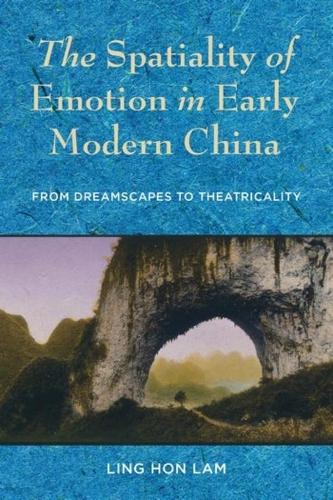
Книга The Spatiality of Emotion in Early Modern China: From Dreamscapes to Theatricality
Emotion takes place. Rather than an interior state of mind in response to the outside world, emotion per se is spatial, at turns embedding us from without, transporting us somewhere else, or putting us ahead of ourselves. In this book, Ling Hon Lam gives a deeply original account of the history of emotions in Chinese literature and culture centered on the idea of emotion as space, which the Chinese call “emotion-realm” (qingjing).
Lam traces how the emotion-realm underwent significant transformations from the dreamscape to theatricality in sixteenth- to eighteenth-century China. Whereas medieval dreamscapes delivered the subject into one illusory mood after another, early modern theatricality turned the dreamer into a spectator who is no longer falling through endless oneiric layers but pausing in front of the dream. Through the lens of this genealogy of emotion-realms, Lam remaps the Chinese histories of morals, theater, and knowledge production, which converge at the emergence of sympathy, redefined as the dissonance among the dimensions of the emotion-realm pertaining to theatricality.The book challenges the conventional reading of Chinese literature as premised on interior subjectivity, examines historical changes in the spatial logic of performance through media and theater archaeologies, and ultimately uncovers the different trajectories that brought China and the West to the convergence point of theatricality marked by self-deception and mutual misreading. A major rethinking of key terms in Chinese culture from a comparative perspective, The Spatiality of Emotion in Early Modern China develops a new critical vocabulary to conceptualize history and existence.
"Through the analytical prism opened up by the concept of emotion-realm (qingjing), Lam provides a refreshing reading and interpretation of many critical thinkers, including Heidegger, Foucault, and Rancière, as well as psychology and affect theory. . . . Because of its scope of coverage, the book can serve as a reference source for rethinking Chinese literature in relation to modern critical theories." - Journal of Asian Studies
"Lam’s vaulting ambition to retell the story of just about every topic near and dear to the heart of a literary scholar: representation, fictionality, theatricality, emotion, and performance, among others. Amazingly, this tall order is pulled off via an even taller order—a counterintuitive thesis that Lam presents at the outset and defends strenuously and successfully throughout the book: that emotion is less an inside-out psychological or neuro-chemical process than an outside-in spatial process." - Modern Chinese Literature and Culture
"Simultaneously engaging Chinese literary history “on its own terms” and on someone else’s terms (Michel Foucault, Martin Heidegger, Claude Lévi-Strauss, Emmanuel Levinas, Slavoj Žižek, to name a few), [Lam's] The Spatiality of Emotion in Early Modern China offers equally close encounters with both, all the while giving trenchant critique of the very “terms” themselves." - Critical Inquiry
"Ambitiously drawing upon the studies of literature, philosophy, and anthropology/ritual studies, Lam successfully brings the literary representation of emotion in premodern Chinese literature and theater to the fore, highlighting the spatialized
character of emotion in both print and theatricality and the dynamics between performers and spectators. The book enormously contributes to the reader’s understanding of traditional Chinese aesthetics, its cultural production, and the
importance of spatialized emotion in Chinese cultural representation" - The Chinese Historical Review
"Spatiality of Emotion in Early Modern China is a heavy read with rewarding and informative rabbit holes into the development of essential aspects of Chinese drama in comparison with their European counterparts." - Asian Review of Books
"Ling Hon Lam’s book opens new dimensions for studying emotion by reaching beyond the well-trodden paths of late imperial China." - Chinese Literature: Essays, Articles, Reviews
"The Spatiality of Emotion in Early Modern China: From Dreamscapes to Theatricality is a bold reconceptualization of fundamental questions in ontology, epistemology, and ethics." - Journal of Chinese Oral and Performing Literature
"Ling Hon Lam has written a book that makes important contributions both to the study of early modern Chinese drama and to broader discussions of affect theory by adding Chinese studies to this scope." - Asian Theatre Journal
"Provocative and ambitious." - China Review International