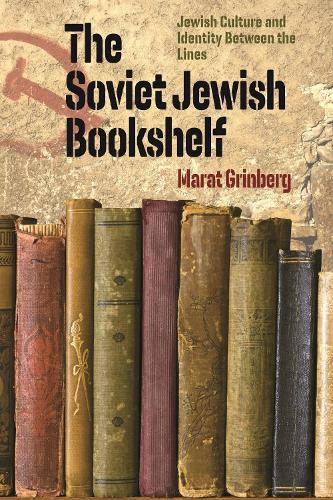
Книга The Soviet Jewish Bookshelf – Jewish Culture and Identity Between the Lines
An original investigation into the reading strategies and uses of books by Jews in the Soviet era.
In The Soviet Jewish Bookshelf, Marat Grinberg argues that in an environment where Judaism had been all but destroyed, and a public Jewish presence routinely delegitimized, reading uniquely provided many Soviet Jews with an entry to communal memory and identity. The bookshelf was both a depository of selective Jewish knowledge and often the only conspicuously Jewish presence in their homes. The typical Soviet Jewish bookshelf consisted of a few translated works from Hebrew and numerous translations from Yiddish and German as well as Russian books with both noticeable and subterranean Jewish content. Such volumes, officially published, and not intended solely for a Jewish audience, afforded an opportunity for Soviet Jews to indulge insubordinate feelings in a largely safe manner. Grinberg is interested in pinpointing and decoding the complex reading strategies and the specifically Jewish uses to which the books on the Soviet Jewish bookshelf were put. He reveals that not only Jews read them, but Jews read them in a specific way.
"“[An] informative, engagingly written work that . . . pairs thorough research with the personal reading experiences of the author and those close to him.”" - Los Angeles Review of Books
"“Grinberg’s The Soviet Jewish Bookshelf is mandatory reading for students of Soviet and Jewish history. There is also much in it for the larger Jewish reading public for whom Soviet Jews remain a paradox, a story that is not merely of survival, but also of fashioning a durable path to Jewishness uniquely their own.”" - Jewish Journal
"“This academic book offers deep insights into decades of Soviet Jewish culture, considering how they read, and what they wrote, all under the deep blanket of repression.”" - Bookishly Jewish
"“As Grinberg shows in his book The Soviet Jewish Bookshelf, Soviet Jews had a deep interest in books on Jewish topics. Their bookshelf was quite wide. Here were Russian translations of Yiddish and Hebrew, of world fiction, original works of Soviet authors, popular historical and philosophical books, and even the anti-Zionist propaganda since it also contained bits of useful information. . . . Particularly interesting is Grinberg’s ingenious analysis. . . . of the works of the brothers Arkady and Boris Strugatsky.”" - Forward
"“Undoubtedly—as Grinberg states—we can and should talk about the existence of Soviet Jewish culture which, although very heterogeneous, was nevertheless capable of struggling to organize, recreate, and preserve its own Jewish self. The author of the book has therefore achieved his goal—to break the silence around Wiesel’s silent Jews.” " - Iudaica Russica
"“Grinberg conveys with special power the way in which Soviet Jews embraced the Russian literary tradition. . . . We live in an age when totalitarian ways of thinking are on the rise and anti-Semitism has again begun to flourish. If we are to combat these trends, we must understand them.”" - Gary Saul Morson, Mosaic Magazine