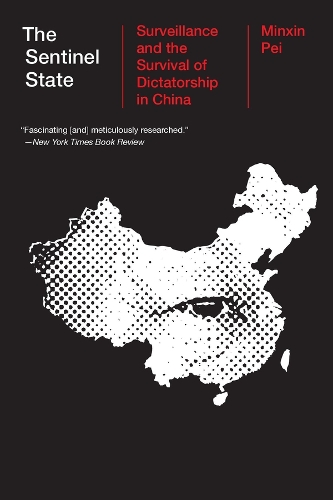
Книга The Sentinel State: Surveillance and the Survival of Dictatorship in China
Countering recent hype around technology, a leading expert argues that the endurance of dictatorship in China owes less to facial recognition AI and GPS tracking than to the human resources of the Leninist surveillance state.
China watchers long argued that economic liberalization and prosperity would be harbingers of democracy. Instead, the Communist Party’s grip has strengthened. How? The answer lies in the effectiveness of the surveillance state. And the source of that effectiveness is not just facial recognition AI and phone tracking. Technology is important, but what matters more is China’s vast army of domestic spies.
Central government surveillance data is confidential, so Minxin Pei turned to local reports, police gazettes, leaked documents, and interviews with exiled dissidents to provide a detailed look at the evolution, organization, and tactics of the surveillance state. Following the 1989 Tiananmen uprising, the Party invested in a coercive apparatus operated by a small number of secret police capable of mobilizing millions of citizen informants. The Party’s Leninist bureaucratic structure—whereby officials and activists penetrate every sector of the economy and civil society, from universities to delivery companies to monasteries—ensures that Beijing’s eyes and ears are everywhere.
Rigorously empirical and rich in historical insight, The Sentinel State is a singular contribution to our knowledge about Chinese state coercion and, more generally, the survival strategies of authoritarian regimes.
"In his fascinating, meticulously researched ‘The Sentinel State,’ Pei focuses on how the Chinese government upgraded its surveillance capabilities to prevent another social movement like the one that inspired the 1989 Tiananmen Square uprising." - New York Times Book Review
"Mr. Pei’s impressive research includes his examination of hundreds of official and leaked government documents as well as his interviews with dissidents who offer accounts of the surveillance they have been subjected to…[his] chronicle ranges across recent Chinese history — from Mao’s China to the post Tiananmen Square period to the increasingly oppressive watchfulness of Xi Jinping’s regime today." - Wall Street Journal
"Pei believes it is surveillance, and not the oft-cited factors of economic growth, nationalism, and the culture of deference, that is ‘the key to the survival’ of the Chinese communist party-state. Such a robust system could fail only if the government’s revenue managers failed to raise enough tax money to support it." - Foreign Affairs
"Unravels the CCP’s vast surveillance apparatus in extraordinary detail….an eye-opener for anyone interested in authoritarian surveillance and the politics and governance of China." - Pacific Affairs
"An authoritative study of China’s surveillance system and its ability to strangle any possible dissent…Pei reveals the vast machinery of surveillance and repression in China, fueled by leaders’ fear, distrust, and paranoia." - Kirkus Reviews (starred review)
"Pei ably untangles and demystifies the Chinese surveillance system: for all its obscure and sinister aura, he paints it as the work of harried bureaucrats who struggle with glitchy equipment and unproductive employees…It adds up to a clear-eyed account of China’s surveillance crusade." - Publishers Weekly