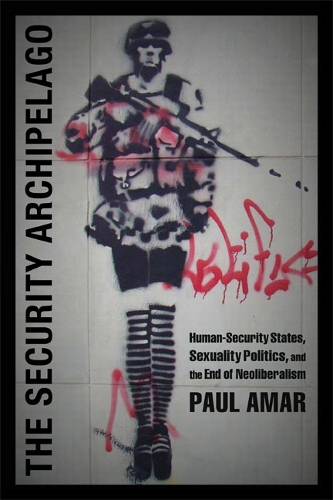
Книга The Security Archipelago: Human-Security States, Sexuality Politics, and the End of Neoliberalism
An alternative framing of the refashioning of free-market states and the rise of humanitarian security regimes in the Global South
In The Security Archipelago, Paul Amar provides an alternative historical and theoretical framing of the refashioning of free-market states and the rise of humanitarian security regimes in the Global South by examining the pivotal, trendsetting cases of Brazil and Egypt. Addressing gaps in the study of neoliberalism and biopolitics, Amar describes how coercive security operations and cultural rescue campaigns confronting waves of resistance have appropriated progressive, antimarket discourses around morality, sexuality, and labor. The products of these struggles—including powerful new police practices, religious politics, sexuality identifications, and gender normativities—have traveled across an archipelago, a metaphorical island chain of what the global security industry calls "hot spots." Homing in on Cairo and Rio de Janeiro, Amar reveals the innovative resistances and unexpected alliances that have coalesced in new polities emerging from the Arab Spring and South America's Pink Tide. These have generated a shared modern governance model that he terms the "human-security state."
"The Security Archipelago accomplishes several theoretical and methodological feats through his combination of archival, ethnographic, and fieldwork research.... The Security Archipelago is a necessary read for anthropologists interested in the Middle East, South America, transnational anthropology, urban studies, securitization studies, studies of the state, and, finally, feminist and queer theory." - American Anthropologist
"This book is overwhelming in the best way possible, combining ethnography with theoretical finesse. His chapters draw upon and speak within and between the fields of political anthropology, comparative political studies, critical security studies, queer studies, urban development, political economy, peace studies, and feminist International Relations." - International Studies Review
"“Amar’s analysis of the politics and culture of the human-security state provides an alternative and declining history of neoliberalism. . . . He pushes critical security studies forward when he questions whether decisions to disregard the Global South contribute to the field’s tendency to legitimate securitization.” " - Powerlines
"“Amar traces the contradictory contours of state power, more interested in its own survival than that of its citizens. Especially for scholars of the changing global status of gender and sexuality, this is a book which expands the scope of the field.”" - New Political Science
"The book puts forth numerous ground-breaking arguments that will enable its readers to rethink the very nature of contemporary neoliberal governance, humanitarianism, and the relation between the global North and global South. It speaks very clearly to contemporary political struggles surrounding state security logics, militarism, sexuality, and human trafficking, but in ways that are entirely unanticipated." - GLQ
"“Through the lenses of the intensely overlapping realms of morality and urban politics, The Security Archipelago provides a new map that refigures how rule works and how it fails to work. … Amar poses the labor of the activist as a form of theorization. Dissidents and revolutionaries are, after all, the social theorists whomthe experts must finally listen to, as Amar does so carefully and attentively in this work.”" - Journal of Middle East Women's Studies
"“[T]his is an ambitious text, and one that offers much for scholars to work with and on which they may build. Amar has articulated a generative framework for thinking about the ways in which political formations develop and spread. Furthermore, he has linked a variety of social, cultural, and economic phenomena to processes of governance and securitization in novel ways that may be productively mobilized in future scholarship.”" - Journal of Latin American and Caribbean Anthropology
"“The Security Archipelago is a prescient interdisciplinary analysis that anticipates the Arab rebellions in Cairo and locates them in a longer history of what Amar calls ‘human security states.’ … The Security Archipelago helps us understand how both visions for the global South employ a discourse of human security.”" - American Quarterly
"“The book is smart, creative, and deserves to be widely read. . . . [A]dvanced students and scholars of the anthropology of policing, governmentality, sexual politics, the rising Global South, Brazil, or Egypt, will find The Security Archipelago to be a bold and intellectually provocative contribution to these fields of inquiry.”" - American Ethnologist
"“[W]ide-ranging case studies ground the book’s critical security analysis in sites of struggle, making important contributions to the understanding of the spread of urban violence and progressive social policy in Brazil and the rise of left-right coalitions in Islamic urban planning and revolutionary uprisings in Egypt. … Amar’s book offers a two-pronged challenge to dominant theories of neoliberalism.”" - boundary 2
"Paul Amar’s The Security Archipelago has received (well-deserved) attention for its interventions into political science discussions of security, into queer studies discussions of sexuality, and within the general academic humanities for its arguments concerning a transition from neoliberalism to human security. What Amar’s The Security Archipelago proposes is nothing less than the thesis that neoliberal forms of governance in the Global South, which feature market legitimation and consumer subjectivity, have been overcome by forms of human security governance. … Amar’s work gives Latin Americanists a way into discussions of sexuality and race which don’t collapse into the dreaded identity politics." - Pública Común