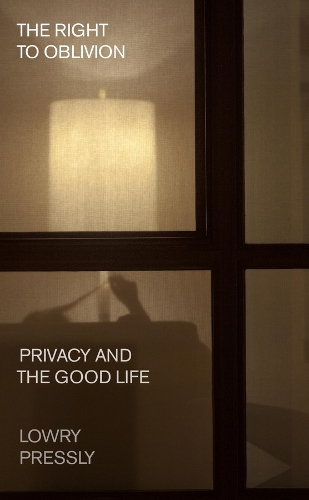
Книга The Right to Oblivion: Privacy and the Good Life
A New Yorker Best Book of the Year
“A probing critique of a modern public sphere that overwhelms the private realm . . . Pressly offers a unique vision of what can be gained by stepping back from the outside world, and the screens that try to possess us.” —John Kaag, The Atlantic
A visionary reexamination of the value of privacy in today’s hypermediated world—not just as a political right but as the key to a life worth living.
Today, almost nothing in our digital lives escapes surveillance. We are able to configure privacy settings on our devices and social media platforms, but we know our efforts pale in comparison to the scale of surveillance capitalism and algorithmic manipulation. Many now wonder whether it is still possible to live a private life, or whether privacy is even worth fighting for.
The Right to Oblivion argues incisively and persuasively that we still can and should strive for privacy, though for different reasons than we might think. Debates about privacy often equate personal data breaches with violations of individual freedom. Yet, as Lowry Pressly argues, privacy isn’t simply a right to be protected, but a tool for making life meaningful.
Privacy deepens our relationships with others as well as ourselves, reinforcing our capacities for agency, trust, play, self-discovery, and growth. Without privacy, the world would be shallow, lonely, and inhospitable. Drawing inspiration from the likes of Hannah Arendt, Jorge Luis Borges, and a range of contemporary artists, Pressly shows why we all need a refuge from the world: not a place to hide, but a psychic space beyond the confines of a digital world where the individual is treated as mere data.
"A radiantly original contribution to a conversation gravely in need of new thinking…takes up familiar fixations of tech discourse—privacy, mental health, civic strife—but puts them into such a new and surprising arrangement that they are nearly unrecognizable…Lawyers like to make privacy about process. Pressly makes it about power." - New Yorker
"A probing critique of a modern public sphere that overwhelms the private realm, but it goes further than that...Pressly offers a unique vision of what can be gained by stepping back from the outside world, and the screens that try to possess us." - The Atlantic
"An intricate case for a quite simple and appealing intervention: Sometimes we want others—and even ourselves—not to need to know anything at all. It is Pressly’s contention, and a convincing one, that this particular unknowing ‘is essential for the sense of potentiality, depth, play, and freedom in human affairs.’" - The Nation
"It’s privacy that involves passing your neighbors’ homes and accepting, without much further thought, that you’ll probably never know about their first kisses or whether they pour their bacon grease down the drain. Their depth, and your own, relies on your not knowing; the whole social fabric of the world depends on it; it is beautiful, it is profound, it is robust…[Pressly] draws from a wealth of surprising sources…[and] constructs a vision of private life that needs protecting." - Harper's
"Argues that to think about privacy without thinking about the good life is not to think about privacy at all…[a] major contribution…to the literature on the politics of digital technology." - Contemporary Political Theory