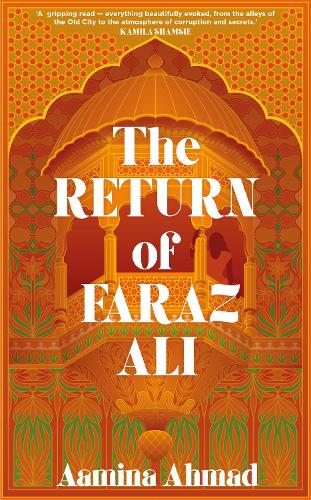
Книга The Return of Faraz Ali
'Stunning, not only on account of the author's talent, of which there is clearly plenty, but also in its humanity' New York Times Book Review
A spellbinding debut set in Pakistan during the anarchic late '60s - a multi-layered tale of family, identity and the politics of power in a caste-ridden society.
As riots erupt on the streets of Lahore, Inspector Faraz returns to his birthplace, the red-light district in the ancient walled city where women still pass on the profession of courtesan to their daughters. Plucked from it as a small boy by his influential father, Faraz has kept his roots well hidden. Now his father has sent him back: to cover up the murder of a young courtesan.
It should be a simple task in the marginalised community, but Faraz finds himself unable to obey orders or to resist searching for the mother and sister he left behind. Chasing down the walled city's labyrinthine alleys for answers that risk shattering his carefully constructed existence, he is unaware that his sister faces having to return too, and to a life she thought she had escaped.
As riveting as it is thought-provoking, as profoundly intimate as it is wide in scope, The Return of Faraz Ali poses a timeless question: whom do we choose to protect, and at what price?
"Stunning, not only on account of the author's talent, of which there is clearly plenty, but also in its humanity, in how a book this unflinching in its depiction of class and institutional injustice can still feel so tender . . . The fullness of the characters and their intersecting lives make this far more than a murder mystery . . . Ahmad's compassion, her deep care for the psychological and emotional nuances of her characters, never wavers . . . It extends through generations and transformations of place, all the way to a devastating final chapter, fully human, fully engaged with what makes us human" - New York Times Book Review
"A stunning debut novel - a noir-inspired thriller that weaves in politics, family ties, corruption and murder, while also being sharp about different kinds of power, particularly as it relates to women." - Observer
"A layered, fascinating portrait of a fractured family and of Pakistan. An impressive, gripping debut" - The Times
"This novel has everything a reader could ask for: a sizzling, noirlike plot; political intrigue juxtaposed with a rich intergenerational family saga; capacious, conflicted characters, including women who may be marginalized by society but are masters of their own narratives; and sublime sentences. A debut novelist, Ahmad manages this complexity seamlessly. A feat of storytelling not to be missed." - Kirkus
"A riveting exploration of the dangers of patriarchy, politics and power." - Monocle
"Extraordinarily accomplished . . . . This is a great novel, rich in setting, shocking in its depiction of brute, inexorable power, but unexpectedly sweet in conclusion." - The Washington Post
"The Return of Faraz Ali is a masterpiece. An intricately woven, deeply affecting labyrinth of history, hope, and longing that fulfils its every great ambition. I'm stunned by the gentle grace and spellbinding storytelling of Aamina, a writer I will return to for years to come." - Fatima Farheen Mirza
"It starts out as a crime novel . . . and then evolves into so much more . . . come for the evocative writing, the subtle characters, and plot - some of which veered in completely unexpected territory." - NPR
"Dark and compelling, this debut novel is one of secrets, murder and loyalty. It's one that will stay with you." - Ms Magazine
"Stunning, not only on account of the author's talent, of which there is clearly plenty, but also in its humanity, in how a book this unflinching in its depiction of class and institutional injustice can still feel so tender . . . The fullness of the characters and their intersecting lives make this far more than a murder mystery . . . Ahmad's compassion, her deep care for the psychological and emotional nuances of her characters, never wavers . . . It extends through generations and transformations of place, all the way to a devastating final chapter, fully human, fully engaged with what makes us human." - New York Times Book Review