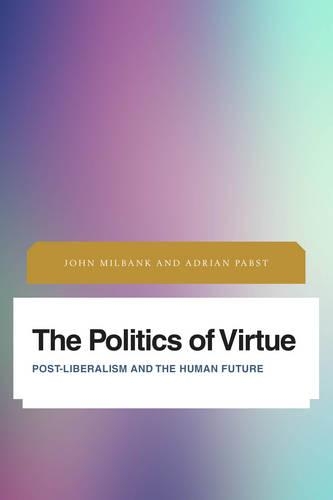
Книга The Politics of Virtue: Post-Liberalism and the Human Future
Contemporary politics is dominated by a liberal creed that champions ‘negative liberty’ and individual happiness. This creed undergirds positions on both the right and the left – free-market capitalism, state bureaucracy and individualism in social life. The triumph of liberalism has had the effect of subordinating human association and the common good to narrow self-interest and short-term utility. By contrast, post-liberalism promotes individual fulfilment and mutual flourishing based on shared goals that have more substantive content than the formal abstractions of liberal law and contract, and yet are also adaptable to different cultural and local traditions. In this important book, John Milbank and Adrian Pabst apply this analysis to the economy, politics, culture, and international affairs. In each case, having diagnosed the crisis of liberalism, they propose post-liberal alternatives, notably new concepts and fresh policy ideas. They demonstrate that, amid the current crisis, post-liberalism is a programme that could define a new politics of virtue and the common good.
"Most critiques of liberalism in the past 200 years—from Marxism, feminism, and poststructuralism—come from the political left. In The Politics of Virtue, Milbank (Nottingham) and Pabst (Kent) challenge liberalism from the right, advocating for a “conservative socialism." Influenced by postmodernism, the authors argue that liberalism destroys itself by abstracting from the human good and treating each individual impersonally, thereby allowing ever more authoritarian tendencies into liberal politics in order to maintain control over a populace whose desires are unfettered by traditional social order. In place of liberalism’s primacy of individual rights, the authors defend the primacy of associations of all kinds—religions, regions, localities, unions, voluntary organizations—that arouse citizens’ sense of civic duty and responsibility, and check the centralizing tendency of liberal governments. The book has five synoptic parts—politics, economy, polity, culture, and world—and matches its ambitious scope with the difficult project to bring abstract theoretical discussion down to policy specifics. What emerges is an exciting, enthralling alternative, though the authors remain unclear about which liberalism they take aim at—there are now many liberalisms in theory and practice. Summing Up: Recommended. Upper-division undergraduates through faculty." - CHOICE
"This book is at once profoundly disturbing yet also compelling, and full of exciting ideas about how to moralise the market and reclaim democracy. It stands as a signature contribution in the emerging debates around post-liberalism and provides real hope as we apparently slide into a post-truth world" - Prospect
"This book could perhaps be called prophetic.... Milbank and Pabst extensively argue these formidable claims, with passion, flair, and flourish and across the fields of politics, economics, constitutional polity, culture, and international relations.... This is a profound and often brilliant cry to recognize the procedural follies and criminalized economics that have converged to undermine the social and cultural relatedness and embeddedness that constitute the true goods of human existence." - The Christian Century
"The Politics of Virtue is clearly an intellectual tour de force. It deals with all the major problems, crises, and metacrises of our time—and does so with intelligence and moral (not moralizing) passion. There surely is an urgent need for both qualities in our contemporary world, ravaged as it is by massive corruption, exploitation, ecological devastation, and the stark danger of nuclear holocaust. To deal with its multiple topics, the book marshals an enviable breadth of expertise, cutting across the usual barriers between politics, economics, psychology, anthropology, philosophy, and theology. One can only wish that academic border-crossing of this kind would become a more widespread habit. Needless to say, in my above account, I could only touch on some highlights of the book. Actually, the text is chockfull of valuable insights—sometimes provocative insights—on numerous topics…. [O]ne can only wish the book the largest possible readership." - The Review of Politics
"It is, of course, an ancient perception that democracy is not bound to produce equality and justice. Milbank and Pabst focus their exposition of this ancient truth on the abstract tendency of democratic procedure to eliminate one-sided initiatives from public decision-making, so defying the conditions of life in time, ‘both spontanously creative and giving'." - Modern Theology
"The book achieves a rare balance: it offers a deeply informative theoretical account of the historical and philosophical foundations of liberalism to advance the case for post-liberalism, along with a remarkably detailed account of the practical implications of post-liberal politics." - Temenos Academy Review
"Milbank and Pabst are to be congratulated for producing the best clarification and refutation of liberal metaphysics in English [...] They bring a wonderful sense of outrage and humor to arguing against all the pallid shibboleths of the age." - First Things