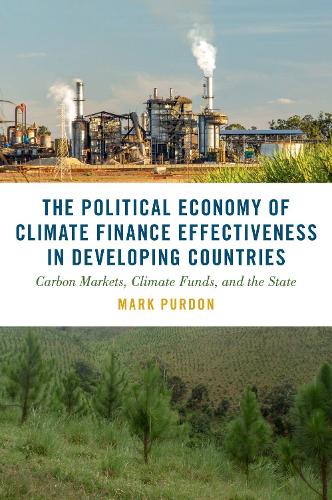
Книга The Political Economy of Climate Finance Effectiveness in Developing Countries: Carbon Markets, Climate Funds, and the State
There is ample evidence that engaging developing countries on climate change mitigation would have significant, positive impacts on global climate efforts. There is much debate, however, on the most effective strategy for unlocking these low-cost mitigation opportunities. While the Clean Development Mechanism (CDM) emerged as the main climate finance instrument for engaging developing countries under the Kyoto Protocol, the carbon market approach it embodied would largely be replaced by a new array of climate finance instruments based on climate funds. In The Political Economy of Climate Finance Effectiveness in Developing Countries, Mark Purdon shows that the effectiveness of climate finance instruments to reduce emissions under either strategy has depended on the interaction between prevailing ideas about how to develop a nation's economy, as well as state interests in various economic sectors. Based on multiple field visits over a decade in three countries, the author demonstrates that climate finance instruments have been more effectively implemented when the state treats them as vehicles for addressing priority development issues. Climate finance instruments were more consistently and effectively implemented in Uganda and Moldova than Tanzania, despite differences in state capacity between countries. This pattern held for the CDM, as well as subsequent instruments largely based on climate funds, such as Reducing Emissions from Deforestation and Forest Degradation (REDD+) and other national mitigation actions. Contributing to broader debates on international climate cooperation, Purdon's findings inform international efforts to support national climate plans and catalyze low-carbon development by emphasizing the importance of domestic politics and the state.
"With careful attention to domestic politics, Professor Purdon provides a detailed, nuanced, and timely contribution to the increasingly contested question of how climate finance instruments are best implemented in lower-income countries." - Elizabeth J. Z. Robinson, Director of the Grantham Research Institute on Climate Change and the Environment, London School of Economics and Political Science
"If you are searching for empirical evidence on the effectiveness of climate finance instruments in developing countries, this is the book you need. It helps one to understand political economy factors that are critical for their effective implementation. Above all, the book brings a fresh perspective on the role of the state in shaping the effectiveness of climate finance instruments." - Patrick Byakagaba, Senior Lecturer, Department of Environmental Management, Makerere University
"This book is an empirically rich exploration of the politics of transition to low-carbon development in low-income countries. By taking a historically grounded, comparative analysis of climate finance implementation in Tanzania, Uganda, and Moldova, Purdon offers an illuminating contribution to the growing literature on developmental environmentalism. The book presents key findings from a decade-long investigation and reveals how the developmental state remains central amidst a plethora of global environmental norms. A must read for anyone interested in recentring the state in the politics of climate finance within the global south." - W. R. Nadège Compaoré, Assistant Professor of International Relations, University of Toronto