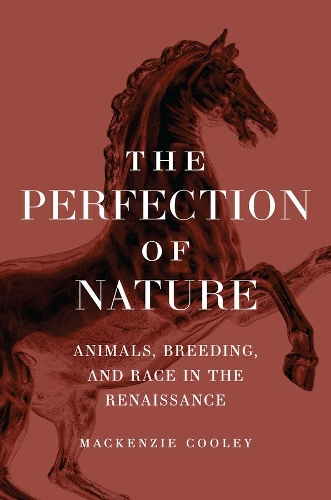
Книга The Perfection of Nature: Animals, Breeding, and Race in the Renaissance
A deep history of how Renaissance Italy and the Spanish empire were shaped by a lingering fascination with breeding.
The Renaissance is celebrated for the belief that individuals could fashion themselves to greatness, but there is a dark undercurrent to this fêted era of history. The same men and women who offered profound advancements in European understanding of the human condition—and laid the foundations of the Scientific Revolution—were also obsessed with controlling that condition and the wider natural world.
Tracing early modern artisanal practice, Mackenzie Cooley shows how the idea of race and theories of inheritance developed through animal breeding in the shadow of the Spanish Empire. While one strand of the Renaissance celebrated a liberal view of human potential, another limited it by biology, reducing man to beast and prince to stud. “Race,” Cooley explains, first referred to animal stock honed through breeding. To those who invented the concept, race was not inflexible, but the fragile result of reproductive work. As the Spanish empire expanded, the concept of race moved from nonhuman to human animals. Cooley reveals how, as the dangerous idea of controlled reproduction was brought to life again and again, a rich, complex, and ever-shifting language of race and breeding was born.
Adding nuance and historical context to discussions of race and human and animal relations, The Perfection of Nature provides a close reading of undertheorized notions of generation and its discontents in the more-than-human world.
"“In Mackenzie Cooley’s erudite new history, The Perfection of Nature, the story of animal breeding provides the basis for a . . . reconsideration of human-animal relations in sixteenth-century Europe and America.”" - London Review of Books
"“In The Perfection of Nature, Cooley opens a rich archive of sources that speak to topical questions around animal difference, race, colonial history, and indigenous knowledge. She delivers a carefully researched study that provides fascinating new insights into the history of breeding and human intervention, inviting us to think about human-nature relationships and the genealogy of current discussions. Highly recommended!”" - Isis
"“A tremendously rich and intellectually stimulating study that is of interest to the history of knowledge as well as to environmental history and animal history.” " - Sehepunkte
"“An important contribution to our understanding of the ways philosophies of selective breeding emerged, converged, and changed over the course of the long sixteenth century. . . . Cooley’s wide-ranging case studies offer a new and valuable demonstration of the ways that a desire to ‘improve’ nature figured in belief systems and interspecies encounters over the long sixteenth century. Her exploration of how specific instances of selective breeding were represented, thought, and practiced sheds light on the complex, uneven evolution of breed and race as categories of identity, and suggestively connects Renaissance thought to concepts such as eugenics or branding that are typically associated with the post-Enlightenment era. Beyond its clear relevance for transatlantic scholarship on Renaissance Spain, then, this book will also be an invaluable resource for animal studies scholars interested in questions about the entangled histories of breed and race that we continue to grapple with today.” " - Humanimalia
"“The Perfection of Nature is a meticulously researched and engagingly written book that offers new insights into Renaissance cultures of animal breeding. Cooley makes innovative use of an eclectic range of source material—including Mexican codices, Jesuit natural histories, and Italian horse-training manuals—and weaves these diverse elements together to make a nuanced but persuasive argument. Her book will be of interest to scholars working on the history of animals, the history of science, the history of race, and the history of Spanish empire.”" - Hispanic American Historical Review
"“Cooley’s work explores an admirable range of topics, draws on a formidable array of sources and deploys diverse methods to produce its arguments. It also displays an admirable commitment to drawing on research from disciplines that rarely feature in historical studies, such as palaeozoology. The resulting book provides a valuable, readable and thought-provoking contribution to discussions of the origins of modern conceptions of heredity and race.”" - British Journal for the History of Science
"“The Perfection of Nature was a pleasure to read. It is an impressive contribution to our understanding of premodern science and the roots of race thinking, rigorous and well-written. The chapters could all easily be assigned to undergraduates who will be delighted with [Cooley’s] descriptions of everything from ceremonial llamas to Chinese crested dogs; the entire volume should find a place on graduate reading lists as it is a model of how to make the past resonate with the present.”" - Sixteenth Century Journal
"“This is a thoughtful book that all scholars of early modern history should read. Cooley reveals a world where ideas about race and the implications of breeding were complex and fluid, when applied to animals, and rarely developed, when applied to people. Certainly, animals could serve as metaphors for human experience, but later horrific ideas about eugenics and even blood-based ideas about race remained largely in the future. Each chapter of this book presents a thoughtful and interdisciplinary analysis based on an impressive range of often disparate sources. Like the best recent studies from the history of science, it convincingly shows the contributions of artisans as well as theoreticians to how people understood and sought to control different kinds of animals. The book’s loose structure, with each chapter almost seeming like an essay on a theme, adds to the emphasis of the argument about fluidity and dialogue rather than linearity and stability. The Perfection of Nature is an important study with which a wide range of subfields will grapple for years to come.”" - H-Sci-Med-Tech
"“As beautifully written as it is conceptually and theoretically ambitious, Cooley’s The Perfection of Nature: Animals, Breeding, and Race in the Renaissance is a true renaissance book. This stunning work of scholarship addresses materials from multiple languages and national contexts to reveal the conceptual limitations imposed by the divisions between theoretical schools and methods, on the one hand, and modern divisions among literature, science, political theory, philosophy, and history, on the other. Uncovering how the subject of animal breeding was not ancillary to early modern scholarship and notions of the human, The Perfection of Nature brings together critical race studies, animal studies, and posthumanist studies—and reaches beyond these areas through the depth and breadth of its synthesis of classical philosophy, medieval scholasticism, and early modern political theory, philosophy, and medicine and science.”" - MLA Aldo and Jeanne Scaglione Prize for Comparative Literary Studies Committee Citation (Honorable Mention)