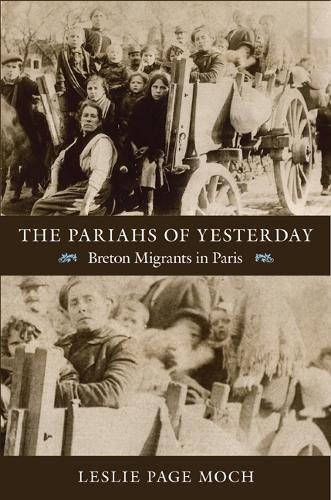
Книга The Pariahs of Yesterday: Breton Migrants in Paris
This is a book about migration. Specifically it looks at the surge of Bretons who left their homes in Western France in the latter half of the nineteenth century to live and work in Paris. Portrayed as backward, ignorant peasants they found no welcome until after the second world war, when they were replaced by Eastern European and African migrants who in turn were denigrated as unworthy and unwelcome. This pattern of disdain and eventual acceptance of migrants is applicable to many countries and many times and Moch positions her work within immigration theory, connecting migration studies to theories about state projects of assimilation and about cultures of inclusion and exclusion.
Beginning in the 1870s, a great many Bretons—men and women from Brittany, a region in western France—began arriving in Paris. Every age has its pariahs, and in 1900, the “pariahs of Paris” were the Bretons, the last distinct group of provincials to come en masse to the capital city. The pariah designation took hold in Paris, in Brittany, and among historians. Yet the derision of recent migrants can be temporary. Tracing the changing status of Bretons in Paris since 1870, Leslie Page Moch demonstrates that state policy, economic trends, and the attitudes of established Parisians and Breton newcomers evolved as the fortunes of Bretons in the capital improved. The pariah stereotype became outdated. Drawing on demographic records and the writings of physicians, journalists, novelists, lawyers, and social scientists, Moch connects internal migration with national integration. She interprets marriage records, official reports on employment, legal and medical theses, memoirs, and writings from secular and religious organizations in the Breton community. As the pariahs of yesterday, Bretons are an example of successful integration into Parisian life. At the same time, their experiences show integration to be a complicated and lengthy process.
"“Leslie Page Moch has provided a unique perspective on the migrants’ family networks and friendships, and on the realities of working life . . . It is a compelling story and one that will interest historians of migration, immigration, and the Breton diaspora.”" - American Historical Review
"“The Pariahs of Yesterday provides a sensitive model that can be applied to the study of many settlement processes in unfriendly environments."" - Journal of Interdisciplinary History
"“Her work paints a vivid picture of [Breton’s] experiences and the changing nature of their place in France and she rightly calls on French historians to better integrate external and internal migration into their scholarship.”" - H-France, H-Net Reviews
"“[A]n important book on the migration of Bretons to Paris during the Third Republic…. The research is meticulous and wide-ranging, combining social science calculations with analysis of oral history and other documents, literary texts and early scholarly treatments of the Breton immigration 'problem.'"" - Canadian Journal of History
"“Pariahs of Yesterday offers a thoughtful exploration of the lives of Breton migrants to Paris…. Pariahs, especially through the inventive use of the actes de mariage, succeeds in excavating the lives of average Breton migrants in Paris, lives that scarcely reflected popular stereotypes of the Breton. Moreover, Moch connects to a broader literature on regional and national identity by demonstrating that, as Bretons adjusted to life in Paris, they could simultaneously embrace their regional and national identities.”" - History: Reviews of New Books
"“This new book will surely stand as the definitive account, in any language, of Breton migration to Paris from the nineteenth century into the twentieth. Building on a considerable body of work on immigration to Paris, Leslie Page Moch provides a model study of the last major group of French migrants to travel from the countryside to the capital.” " - The Historian