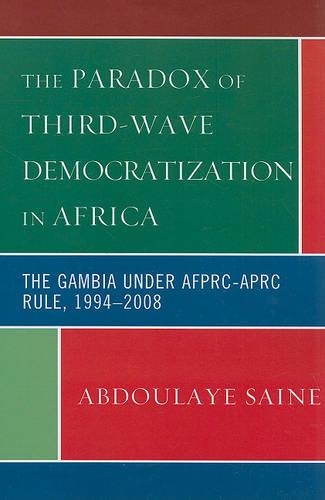
Книга The Paradox of Third-Wave Democratization in Africa: The Gambia under AFPRC-APRC Rule, 1994-2008
This book is about the dilemma(s) of 'third-wave' 'democratization' in Africa. It teases out the general proposition that while the market is a necessary ingredient for development, it is not by itself a sufficient condition for prosperity_the state's role, policy framework, and leadership also matter. Using a counter-example, the book contends that in a poor governance environment, gross human rights violations result in poor economic performance and failure by repressive governments to provide basic needs for the poor in society. While this study is concerned primarily with The Gambia, it nonetheless has a lot to say about Zimbabwe, Zambia, Kenya, Nigeria, Ghana, Senegal, and other countries in the continent caught in the paralysis of externally driven political and economic transitions and globalization. Locating countries undergoing liberalization and democratization within the global economy_as well as their peripheral status within it_is important, as patterns of contemporary globalization are highly asymmetrical and often associated with a democratic deficit. Consequently, some groups, classes, and states enjoy numerous political and economic freedoms foreign to the vast majority of humanity, which lives in oppressive living conditions. The Paradox of Third-Wave Democratization in Africa is also a comprehensive account of the historical, political, and economic events since the onset of military and quasi-military rule in this West African mini-state of 1.5 million, once the longest surviving functioning democracy in Africa. Predictably, the book is about former President Dawda Jawara as much as it is about soldier-turned-president Yahya Jammeh, who in the last fourteen years has dominated the country's political and economic landscape. In the end, the book posits that various attempts to improve living standards of ordinary Gambians and Africans by client regimes using foisted conventional market-driven economic models alone are not likely to succeed until they are predicated on a basic-needs economic strategy and organically spawned political structures. Finally, the book highlights transnational political and economic ties Diaspora Gambians have established with The Gambia and their attempts to both shape and nudge politics in the second republic in a more democratic direction.
"This is unquestionably an important book.... He offers—in the book and very uniquely—lucid, clear, coherent, original, important and critical insights into our understanding of contemporary Gambian politics.... A worthwhile book for policy makers, politicians, journalists, researchers, students, development practitioners, among others.... It deserves a permanent place on our book shelves.... Entertaining to read, filled with intriguing detail.... Immensley useful.... Thoroughly researched.... Dr. Saine has written one of the most comprehensive and compelling studies of Gambian politics to date.... Lively, informative and strongly recommended." - The Gambia Echo
"This book seeks to analyze and interpret the history of The Gambia since the military coup of 1994, applying a variety of the theoretical perspectives to issues of governance, socioeconomic development, and human rights…Recommended." - CHOICE
"Saine recommends a series of major policy changes to bring political democracy, economic development, and respect for human rights to the people of his homeland. This volume is best suited for university libraries, collections specializing in international affairs, African studies, and military affairs, and larger public library systems... Recommended." - CHOICE, November 2009
"Saine here offers well-informed historic and political analysis. . . . its analysis is greatly enriched by careful comparisons drawn to similar developments in other young African nations. . . . The strengths and contributions of the book are many, as Saine provides a coherent, transparent, and critical evaluation of Gambian political history. . . . Saine's analysis makes great strides at getting to the heart of factors that truly matter and come into play in the successful development — or, conversely, the deterioration — of young nations. . . . Most certainly, Saine's book is a well-researched contribution to what is already known abou tthe political history of the Gambia." - Africa Today