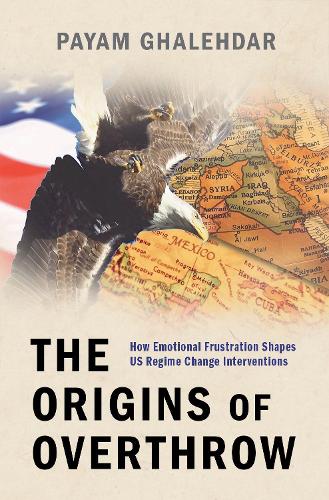
Книга The Origins of Overthrow: How Emotional Frustration Shapes US Regime Change Interventions
Why has the United States repeatedly engaged in the overthrow of foreign leaders and regimes? Although most regime change interventions have neither furthered US national security nor improved the fate of targeted states, the US has turned to this foreign policy instrument in at least sixteen cases from 1906 to 2011. In The Origins of Overthrow, Payam Ghalehdar explains US-imposed regime change by focusing on its emotional underpinnings. Based on a thorough analysis of the emotional state of five US presidents, he shows how "emotional frustration"-an emotional syndrome that combines hegemonic expectations, perceptions of hatred in target state obstructions, and negative affect-has repeatedly influenced US regime change decisions. When US presidents have been gripped by this emotion, Ghalehdar argues, they have turned to the use of force and targeted perceived sources of obstruction in order to ameliorate their emotional state and discharge frustration. Examining five US regime change episodes in two world regions (Cuba 1906, Nicaragua 1909-12, and the Dominican Republic 1963-65 in the Western hemisphere, and Iran 1979-80, and Iraq 2001-03 in the Middle East), he empirically illustrates the emotional sources of US intervention decisions. A novel explanation for a puzzling phenomenon in US foreign policy, The Origins of Overthrow sheds light on how emotions play a previously overlooked role in US regime change decisions.
"In sum, The origins of overthrow not only brilliantly synthesizes research in psychology and international politics to develop the emotional frustration syndrome; it also succeeds in demonstrating the syndrome's impact on US foreign policy ... this is why the book should be required reading for students, scholars and policy -- makers in International Relations alike." - Robin Markwica, International Affairs
"The Origins of Overthrow not only brilliantly synthesizes research in psychology and international politics to develop the emotional frustration syndrome; it also succeeds in demonstrating the syndrome's impact on US foreign policy. This is a combination of theoretical innovation and empirical research in its best form. Ghalehdar's pathbreaking approach advances our understanding of the affective dimension of preference formation and decision-making. In so doing, it offers important insights into the role of frustration as a crucial and hitherto ignored cause of interstate violence. This is why the book should be required reading for students, scholars and policy-makers in International Relations alike." - International Affairs
"In The Origins of Overthrow, Payam Ghalehdar offers an original and convincing interpretation of why US leaders have been so prone to overthrow other governments. Ghalehdar weaves his concept of emotional frustration into a fascinating account that needs to be read by scholars of both international relations theory and history." - Frank Costigliola, Board of Trustees Distinguished Professor of History, University of Connecticut
"Why has the United States used force so often to change other countries' domestic regimes, when the result is seldom worth the cost? Drawing on recent psychological theorizing, Payam Ghalehdar argues that US presidents send in the military when they are emotionally frustrated at a foreign government that is thwarting their hegemonic expectations. Ghalehdar's case, which he makes in clear prose and with copious historical evidence, deserves a wide hearing." - John Owen, Taylor Professor of Politics, University of Virginia
"Drawing on meticulously researched case studies, Payam Ghalehdar compellingly shows how emotions play a key role in foreign policy decision making. He demonstrates that US strategies to impose regime change in foreign countries are as much the result of 'emotional frustration' than they are a matter of geopolitical calculations or ideological differences." - Roland Bleiker, Professor of International Relations, University of Queensland
"Brilliant, provocative, and compelling, this stunning new explanation for why US presidents so often resort to regime change has deeply uncomfortable implications for how we understand foreign policymaking. I can think of few other books I would as urgently put in the hands of US policymakers." - Barbara Keys, Director of Research and Professor of History, Durham University