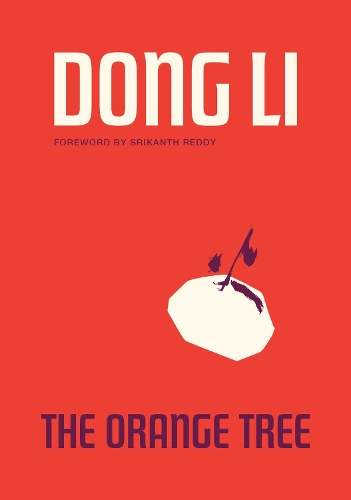
Книга The Orange Tree
Debut collection of poems that weaves stories of family history, war, and migration.
Dong Li’s The Orange Tree is a collection of narrative poems that braids forgotten legends, personal sorrows, and political upheavals into a cinematic account of Chinese history as experienced by one family. Amid chaos and catastrophe, the child narrator examines a yellowed family photo to find resemblances and learns a new language, inventing compound words to conjure and connect family stories. These invented words and the calligraphy of untranslated Chinese characters appear in lists separating the book’s narrative sections.
Li’s lyrical and experimental collection transcends the individual, placing generations of family members and anonymous others together in a single moment that surpasses chronological time. Weaving through stories of people with little means, between wars and celebrations, over bridges and walls, and between trees and gardens, Li’s poems offer intimate perspectives on times that resonate with our own. The result is an unflinching meditation on family history, collective trauma, and imaginative recovery.
The Orange Tree is the recipient of the inaugural Phoenix Emerging Poet Book Prize for 2023.
"Li’s method of blurring the distinction between singular and plural is in perpetual service to the book’s tone, one I can best describe as strange, mournful, and obliquely beautiful. . . . Li is a sure-footed guide. The Orange Tree avoids the affective pitfalls of both the memoir and the chronicle, replacing the nostalgia of the former with a clipped aloofness, and countering the roteness of the latter with an insistent, unflinching imagism. . . . Li’s poems introduce the reader to a way of seeing that is not unlike his own approach to history, a reconciliation of individual and collective scales. With unsentimental conviction rather than didacticism, The Orange Tree restores dignity to those whose lives and deaths were forgotten, or worse, remembered falsely, turned into propaganda, patronized, or pitied. The stories of these lost ones may lack a preexisting language, but that does not mean they are untellable; no matter how faded a photograph is, our minds will still fill in the outlines." - Los Angeles Review of Books
"What Li, the recipient of the inaugural Phoenix Emerging Poet Book Prize, does in his first collection is combine the excruciatingly personal with an essential oral history of China. The poet compounds words into feelings so readily familiar that by reading them one is immediately transposed to a different place and into a story. . . . The Orange Tree is, simply put, transformative." - Booklist starred review
"Dong Li’s debut collection is tenderly premised around the multiplicity of language. With a translator’s precision and an ethnographer’s comprehensiveness, The Orange Tree narrates generations of a family’s 20th-century history." - Harriet Books
"The Orange Tree is lyrical and narrative, familial, political, and legendary." - New Books Network
"To read The Orange Tree is to witness the families and voices living through Li’s touch on the page." - Annulet
"They’re narrative poems and you may think they’re about fruit, but they’re so many things—about war, surveillance, migration, family history, pain, and pleasure, all intertwined. It is a book of revelation." - Zocalo Public Square
"This is an interesting book of poems . . . Narrative propels the poems forward, generally, but there’s an occasional strangeness that rattles my ear. I also love poems that rely heavily on imagery." - Kenyon Review, "2023 Summer Reading Recommendations"
"Thoughtful, funny, and deeply interested in what connects us with those around us (literature, plants, poetry, silence), Li is a writer who sees language as a way to call our loved ones back to life. In his debut poetry collection The Orange Tree . . . Li creates a new lexicon of memory. Language, like the past, does not follow a straight line . . . . Li’s work is as experimental as it is true to the rhythm of the human emotional psyche, and his reworking of oral and self-created histories defines him as not just a poet, but as a brilliant taxonomist of human desire."" - Cleveland Review of Books
"Complex, enigmatic, but undeniably compelling in its ephemeral images and bold creative choices. . . Li’s poetry resists any straightforward interpretation. Instead, it encourages the reader to explore its numerous possibilities and the emotive force that drives its images. The poetry moves beyond a recounting of history and charges its scenes with an ethereal quality, giving Li’s words a transcendental effect." - The Harvard Crimson
"The way familial, cultural, and national history unfolds in The Orange Tree leads to a deeper appreciation of language and loss. Li’s English combines the translator’s alertness to the complexities of language with the transnational poet’s varied lexicon." - The Harvard Review