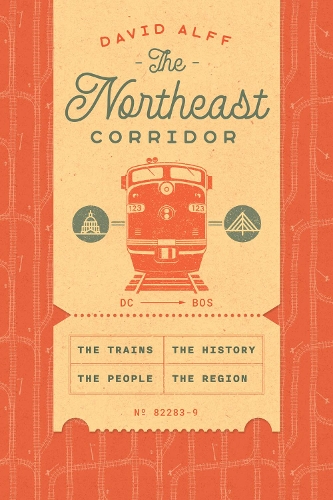
Книга The Northeast Corridor: The Trains, the People, the History, the Region
All aboard for the first comprehensive history of the hard-working and wildly influential Northeast Corridor.
Traversed by thousands of trains and millions of riders, the Northeast Corridor might be America’s most famous railway, but its influence goes far beyond the right-of-way. David Alff welcomes readers aboard to see how nineteenth-century train tracks did more than connect Boston to Washington, DC. They transformed hundreds of miles of Atlantic shoreline into a political capital, a global financial hub, and home to fifty million people. The Northeast Corridor reveals how freight trains, commuter rail, and Amtrak influenced—and in turn were shaped by—centuries of American industrial expansion, metropolitan growth, downtown decline, and revitalization.
Paying as much attention to Canton, Trenton, New Rochelle, and Providence as to New York City, Philadelphia, and Baltimore, Alff provides narrative thrills for history buffs, train enthusiasts, and adventurers alike. What’s more, he offers a glimpse into the future of the corridor. New infrastructural plans—supported by President Joe Biden, famously Amtrak’s biggest fan—envision ever-faster trains zipping along technologically advanced rails. Yet those tracks will literally sit atop a history that links the life of Frederick Douglass, who fled to freedom by boarding a train in Baltimore, to the Frederick Douglass Tunnel, which is expected to be the newest link in the corridor by 2032.
Trains have long made the places that make America, and they still do.
"David Alff employs a historical perspective to explain how trains became essential, if frustrating, fixtures of the bustling metropolises from the Mid-Atlantic to New England. He delves into the political decision-making and compromises that made the corridor what it now is and considers how transformative planned upgrades could be." - Bloomberg
". . . a chronicle filled with reliably fascinating facts." - The Wall Street Journal
"Alff — an English professor at SUNY Buffalo — has put together a history of northeast corridor train service and shows that few of the problems that we’re facing now are new, and almost all of them are rooted in a confluence of cut corners and short-sighted, strategy-free decision making." - New Jersey Monitor
"“a fascinating book of history and, of course, a portent for the future . . . ."" - Peter Greenberg, Eye on Travel
"A masterful summation of how the current corridor came to be. Broad and wide ranging, yet well researched and detailed, it takes the reader on a journey through time the same way a train takes a passenger on a journey through space. Those familiar with transportation history and the history of the corridor from scholars like Churella and Stilgoe will not find much new here, but the presentation is remarkable. Easily readable and gently flowing prose makes details of electric locomotives, political deals, and corporate stock shenanigans accessible and relatable. This may just be the perfect book to read as your Amtrak train glides out of Washington Union station, crosses the Susquehanna, and dives beneath the Hudson River on its way to the heart of Manhattan." - Technology and Culture
"
“Rooted in cultural landscape studies, this readable and engaging book speaks to fields ranging from science and technology studies to US politics, as well as urban, planning, architectural, and environmental histories.”
" - Journal of Planning History"
“The Northeast Corridor offers a superb overview of its namesake region, from the Indigenous presence on the land to twenty-first-century visions for a high-speed, high-tech future. . . . An eminently readable paean to the region.”
" - Journal of American History"One mark of a great writer is an ability to produce beautiful prose even when describing life’s passing banalities. . . . But I assure you this isn’t some art-house meditation on the rail-scarred earth of the mid-Atlantic. Alff has produced a proper history of the eponymous rail line from Boston to Washington, D.C. that became early America’s infrastructural backbone. And somehow, he managed to pack it into a book that’s scarcely more than 250 pages, despite also providing an abundance of memorable digressions into the arts of rail-station architecture, bridge construction, and tunnel blasting." - Quillette