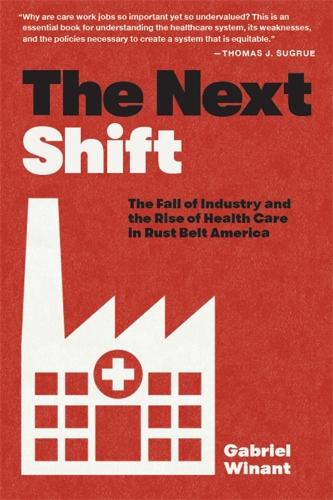
Книга The Next Shift: The Fall of Industry and the Rise of Health Care in Rust Belt America
Winner of the Frederick Jackson Turner Award
Winner of the Isaac and Tamara Deutscher Memorial Prize
Winner of the C. L. R. James Award
A New York Times Book Review Editors’ Choice
A ProMarket Best Political Economy Book of the Year
“The Next Shift is an original work of serious scholarship, but it’s also vivid and readable…Eye-opening.”
—Jennifer Szalai, New York Times
“A deeply upsetting book…Winant ably blends social and political history with conventional labor history to construct a remarkably comprehensive narrative with clear contemporary implications.”
—Scott W. Stern, New Republic
“Terrific…A useful guide to the sweeping social changes that have shaped a huge segment of the economy and created the dystopian world of contemporary service-sector work.”
—Nelson Lichtenstein, The Nation
Pittsburgh was once synonymous with steel, but today most of its mills are gone. Like so many places across the United States, a city that was a center of blue-collar manufacturing is now dominated by health care, which employs more Americans than any other industry. Gabriel Winant takes us inside the Rust Belt to show how America’s cities have weathered new economic realities.
As steelworkers and their families grew older, they required more health care. Even as the industrial economy contracted sharply, the care economy thrived. But unlike their blue-collar predecessors, home health aides and hospital staff work unpredictable hours for low pay. Today health care workers—mostly women and people of color—are on the front lines of our most pressing crises, yet we have been slow to appreciate that they are the face of our twenty-first-century workforce. The Next Shift offers unique insights into how we got here and what could happen next.
"The replacement of blue-collar work by pink-collar work has been much discussed, but what makes this book stand out is Winant’s argument that two seemingly distinct phenomena are in fact inextricably connected…An original work of serious scholarship, but it’s also vivid and readable…[An] eye-opening book." - New York Times
"A deeply upsetting book. It meticulously charts the transformation of the working class to show how the destruction of workers’ unions and bodies occurred in a feedback loop, with capitalist exploitation demanding care, demanding more exploitation, demanding still more care. The demolition of state support and state protections served to speed up this feedback loop. It has long since spun out of control…Winant ably blends social and political history with conventional labor history to construct a remarkably comprehensive narrative with clear contemporary implications." - New Republic
"Winant charts the rise of this new political economy and working class in his terrific new book…Offering fine-grained details of shop-floor industrial relations, the book is at once an ethnographic probe into the lives of working-class families and a comprehensive analysis of the larger dynamics of the US political economy…A useful guide to the sweeping social changes that have shaped a huge segment of the economy and created the dystopian world of contemporary service-sector work." - The Nation
"How the health-care industry replaced manufacturing while downgrading the quality of American middle-class life, furthering inequality, and fueling political bitter divisions is the welcome subject of Gabriel Winant’s The Next Shift…Winant weaves together a convincing argument that this downward mobility has been driven by a gendered and racist political economy that values many things—from retiree health care to CEO pay—more than care work by women and people of color…Many health-care workers on the bottom rungs now find themselves, in some ways, back where industrial workers started in the nineteenth century…[An] important book." - Democracy
"Digs deep into the stories of working people, tracing the rise and fall of two industries that, despite vast differences on the surface, have been intertwined for decades. Through stories of real people’s real lives, Winant explores the move from manufacturing to care, tracing the rise of a new working class—one that looks very different from the stereotypical blue-collar worker of the Rust Belt’s mythic past…A road map for how to think about the changing working class." - Bookforum
"Charts how Pittsburgh’s declining steel industry gave rise to one of the country’s most ruthlessly corporatized health care systems, and how the ability of each to deliver on its romanticized promises rested on the exploitation of care work." - Jacobin
"Winant explains in fascinating detail how Pittsburgh’s working class adapted to the post-steel economy…[O]ffers a highly intelligent case study of the transformation of one key section of the working class since 1950—a vital precondition for mapping its future." - New Left Review
"Essential reading for anyone interested in Pittsburgh history, the labor movement or the economics of our health care system. It helps us to make sense of the region and the economy we inhabit today." - Pittsburgh Post-Gazette
"The definitive account of the causes and consequences of the decline of heavy industry and the birth of the medical-industrial complex. Winant dives deeply into Pittsburgh's economic, social and cultural history to illuminate the linkages between the rise and fall of steel and the spectacular growth of health care…Essential reading for anyone wanting to understand our modern health-care industry's historical and economic foundations." - Inside Higher Ed
"An exquisite regional economic history, The Next Shift illustrates how health care became a primary mechanism of social reproduction—allowing the American state to govern the economic and sociological consequences of deindustrialization…Offers powerful lessons for scholars of health policy and politics." - Journal of Health Politics, Policy and Law
"[An] exhaustive examination of the shifting economies of the American Rust Belt…A fascinating look at labor history and the continuing struggles of blue-collar workers, particularly in light of the pandemic and the increased burden, both personally and politically, placed on health care workers." - Pittsburgh Magazine
"A thorough understanding of the political economy of the post-war United States inflected through the lenses of race, gender and class. It is a masterful book that weaves together two seemingly disparate strands—the demise of heavy industry and the rise of care work—into a single thread that traces the story of a broken society." - Spectrum Culture
"Winant explores in his informative debut the rise and fall of Pittsburgh’s steel industry as a microcosm of America’s shift from an industrial to a service economy." - Publishers Weekly