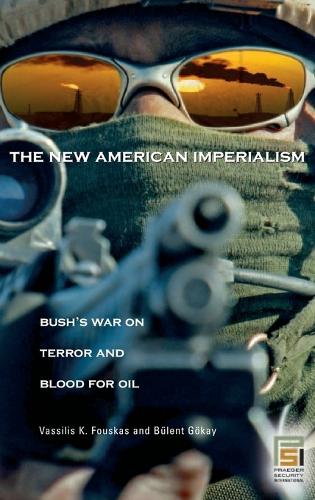
Книга The New American Imperialism: Bush's War on Terror and Blood for Oil
"This timely and insightful work provides a provocative analysis of the dynamics of U.S. power in the age of the 'War on Terror' and the 'Export of Freedom." -- Dan Plesch, Research Fellow at Birkbeck College, University of London "A stimulating and important contribution." -- Leo Panitch, Professor of Politics, University of York, Canada "An innovative and challenging book, essential to understanding Washington's New World Order." -- Donald Sassoon, Professor of Comparative European History, Queen Mary, University of London "This is a brilliant and courageous analysis of the present-day American Empire that we ignore at our own peril." -- Cornel West, Princeton University
With the terrorist attacks of September 11, 2001, the United States' long war on communism was replaced by a perpetual war on terror. The authors posit that this neo-imperialistic phase is but the latest development in a line of thought and action established after World War II. But, they say, 2005 is not 1945. Today, they argue, the United States uses its power to deplete the resources of the developing world, and to compel the rest of the world to remain dependent on American management of the global economy. Contending that this situation is ultimately untenable, they assert that the United States is entering a period of deep crisis. The best thing for American neo-imperialists to do to avert their worst nightmare—a strategic and economic alliance among Europe, Russia, China, and OPEC—would be to arrange for the orderly withdrawal of American power before it is too late for the human and environmental security of the world. When the Soviet Union collapsed in 1991, the Cold War slowly gave way to a new world order in which the United States was left as the lone superpower. But the organizing principle that would characterize the early 21st century was as yet unclear, until the terrorist attacks of September 11, 2001. Now it is clear that the long war on Communism has been replaced by a perpetual war on terror. Regardless of how long American troops remain in Iraq, and irrespective of further military actions, George W. Bush will continue to be a wartime president whose foreign policy is dominated by the Pentagon. And yet, the authors argue, this neo-imperialistic phase, with its emphasis on Eurasian oil supplies, is but the latest development in a line of thinking and acting in the world that was established by such men as Dean Acheson and Paul Nitze after World War II. But 2005 is not 1945, and the United States, despite Secretary of Defense Donald Rumsfeld and Vice President Dick Cheney's assertions, is not liberating Iraq and Afghanistan in the same way that U.S. forces liberated Germany and Japan; it is not reconstructing Iraq or the former Yugoslavia as it did when it rebuilt war torn western Europe with the Marshall Plan. The United States, with its thinly stretched military and deficit-laden economy, does not possess the means to do so today. Instead, the authors maintain, the United States is simply depleting the developing world's natural resources, compelling the rest of the developed world to remain dependent on American management of the global economy. This situation is ultimately untenable, the authors argue, and as a result, the United States is entering a period of deep crisis. The best thing for American neo-imperialists to do to avert their worst nightmare—a strategic and economic alliance among Europe, Russia, China, and OPEC—would be to arrange for the orderly withdrawal of American power before it is too late for the human and environmental security of the world as a whole.
"Recommended. Upper-division undergraduates, graduate students, and faculty." - Choice