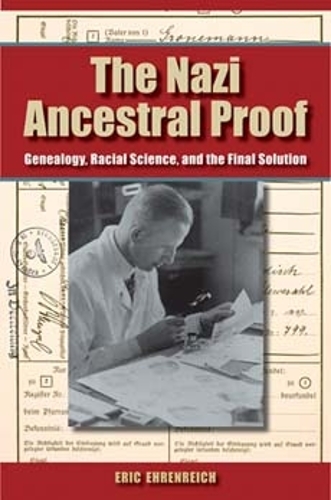
Книга The Nazi Ancestral Proof: Genealogy, Racial Science, and the Final Solution
Traces the origins and implementation of the method by which one proved "racial acceptability" in Nazi Germany
How could Germans, inhabitants of the most scientifically advanced nation in the world in the early 20th century, have espoused the inherently unscientific racist doctrines put forward by the Nazi leadership? Eric Ehrenreich traces the widespread acceptance of Nazi policies requiring German individuals to prove their Aryan ancestry to the popularity of ideas about eugenics and racial science that were advanced in the late Imperial and Weimar periods by practitioners of genealogy and eugenics. After the enactment of Nazi racial laws in the 1930s, the Reich Genealogical Authority, employing professional genealogists, became the providers and arbiters of the ancestral proof. This is the first detailed study of the operation of the ancestral proof in the Third Reich and the link between Nazi racism and earlier German genealogical practices. The widespread acceptance of this racist ideology by ordinary Germans helped create the conditions for the Final Solution.
"
Thoroughly researched and vigorously argued, this study seeks to explain how the National Socialist regime institutionalized its racial ideology, why it met with virtually no opposition, and how this contributed to genocide. Attorney Ehrenreich shows that, as with many other developments, 1933 was not the absolute watershed scholars usually assume it to have been. Tracing the history of genealogical practices, eugenics, and "scientific" racism from the imperial era (1871-1918) into the Weimar years (1919-33), the author reasons that Germans had become thoroughly accustomed to these discourses. Notwithstanding their scientific worthlessness, the Nazi version of these theories met with no meaningful resistance, as millions upon millions of Germans complied with the regime's demands regarding the racial purity of their ancestors. Compliance may have rested on a "combination of perceived benefits" rather than enthusiasm for the ideology, but whatever the basis for public acceptance, it allowed the Nazis to implement thousands of racial laws with virtually no opposition from either institutions or individuals. Whole new branches of commerce emerged to service a new public need—providing the proof that one was untainted by "Jewish blood." Ordinary Germans thus helped identify and isolate Jews, steps that led to their extermination. An important book, accessible to general readers. Summing Up: Highly recommended. All levels/libraries.
" - Choice"
Eric Ehrenreich traces the widespread acceptance of Nazi policies requiring German individuals to prove their Aryan ancestry to the popularity of ideas about eugenics and racial science that were advanced in the late Imperial and Weimar periods by practitioners of genealogy and eugenics. This is a detailed study of the operation of the ancestral proof in the Third Reich and the link between Nazi racism and earlier German genealogical practices. The widespread acceptance of this racist ideology by ordinary Germans helped create the conditions for the Final Solution.
" - SHOFAR"
The ancestral proof ... formed the bedrock of the regime's racial policies ... It is ... surprising that this issue has not received more scholarly attention, and Ehrenreich has made an interesting and valuable contribution by elucidating it.Vol. 42 2009
" - University College London"
In this important study, Eric Ehrenreich demonstrates how genealogical studies and racist eugenics converged to help institutionalize racism in Nazi society.2008
" - GERMAN STUDIES REVIEW"
. . . Washington-based lawyer Eric Ehrenreich has produced the most exhaustive study available on the way in which 19th- and early 20th-century German pseudo science and its Nazi successors carried out a war against non Aryans, particularly Jews.April 15, 2009
" - National Jewish Post and Opinion (KY ed.)"
Peter Fritsche calls Ehrenreich's book 'an excellent contribution to our understanding of racism in the Third Reich' ... Richard Weikart, [on the other hand,] while praising Ehrenreich's explication of [the] Nazi 'ancestral proof,' ... rejects his argument that scientific racism ligitimated but did not lead to the Holocaust. That two reviewers can provide such markedly different assessments of the book suggests that something interesting is going on. And indeed, whether one agrees with Eherenreich or not, his book is worth reading.2009
" - Journal of Genocide Research"
. . . each contribution builds either explicitly or implicitly on the shared working assumption that conventional distinctions between (religious) anti-Judaism and (racialist) antisemitism may conceal as much as they reveal. Traditional anti-Judaism, these scholars agree, both framed and exploited politically instrumentalized forms of cultural and racial antisemitism, reflecting a 'Christian failure to understand and acknowledge Judaism on its own terms' . . . .Vol. 23. 1 Spring 2009
" - Calvin College"
Ehrenreich's book is an extremely well-argued, insightful exposition of the institutionalization of racism in everyday life during the Third Reich.2008
" - H-German"
[P]rovides interesting insights into the institutionalization of racism in Nazi society. 28.4 2010
" - German History"
Ehrenreich tells a fascinating story, and his book is a model of patient research and meticulous archival investigation. . . . a major contribution to the intellectual and social history of Nazism.Vol. 114.4 October 2009
" - John Jay College and the Graduate Center, City University of New York"
Thoroughly researched and vigorously argued, this study seeks to explain how the National Socialist regime institutionalized its racial ideology, why it met with virtually no opposition, and how this contributed to genocide. . . . An important book, accessible to general readers. . . . Highly recommended.November 2008
" - University of Illinois at Chicago