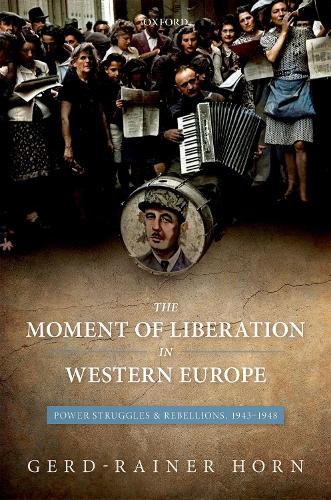
Книга The Moment of Liberation in Western Europe: Power Struggles and Rebellions, 1943-1948
The Moment of Liberation in Western Europe, 1943-1948, regards the final two years of World War II and the immediate post-liberation period as a moment in twentieth century history, when the shape and contours of postwar Western Europe appeared highly uncertain and various alternatives and conflicting visions were up for grabs. After close to six years of total war, Nazi terror, and brutal occupation policies, a growing number of Europeans were no longer content solely to fight for national liberation from fascist control. Having staked their lives in military and civilian resistance to Nazism and Italian fascism across the continent, surviving activists were aiming to ensure that such a political and social catastrophe would never befall Europe again. In the closing moments of World War II, hundreds of thousands of antifascist activists had begun to identify with the famous quote penned by the exiled German social theorists, Max Horkheimer, who had boldly proclaimed in early September 1939: 'Whoever is not prepared to talk about capitalism should also remain silent about fascism.' The economic and political elites in prewar societies were increasingly regarded as co-responsible for war, fascism, and occupation policies, from which many had benefited significantly and often enthusiastically. There were extensive popular social movements at work in almost every single state which aimed to construct postwar societies in which grassroots democracy and the free association of rank-and-file activists would replace the profit principle and the top-down Jacobin orientation by traditional elites. This study for the first time reconstructs the parameters of this contest over the shape of postwar Western Europe from a consistently transnational perspective.
"What is new and has not been dealt with in this breadth ever before is the investigation of grassroots networks which anti-fascist partisans and resistance fighters tried to establish in the transition from underground activism to the struggle for political power. Regardless of their ultimate failure, these experiences convey important historical lessons. These lessons are all the more important as Gerd-Rainer Horn treats his topic from a comparative perspective. He examines important developments in Germany, Italy and France with a sideways glance at Belgium." - Mario Kessler,Das Blättchen, Zweiwochenschrift für Politik, Kunst und Wirtschaft
"...the book is highly original in more ways than one. It underscores the complexity of situations often approached too unilaterally from partial perspectives. This study raises the question of how to exit from a major societal crisis and how to negotiate the difficult articulation between the various interlocking struggles, shaped by the interplay of local forces against the background of a vast political spectrum on national and supra-national levels, a question that we will encounter mutatis mutandis in all subsequent major crises, the contemporary urgency of which will have escaped no one." - Danielle Tartakowsky, Le Mouvement Social
"The book allows one to understand the political context of sometimes insurrectional struggles for power, shaping the modalities of post-war reconstruction. The author emphasizes the importance of grassroots networks of resistance fighters, far from the circles of political power and confronted with the difficulties of daily life, calling into question the pre-war elites in an attempt to substitute local powers to a Jacobin logic. The book ends with a rich and stimulating bibliographical essay covering the entire range of countries analyzed." - Christian Chevandier, Francia Recensio
"Horn has presented an impressive book in which he merges the many individual examples of liberation committees, freewheeling newspapers, and imaginative actions by various levels of official administrations and factory militants into a convincing overall picture. In doing so, he makes use of a lively, graphic, vivid language which captures the mood of this promising conjuncture - with a tendency to catchy formulations." - Florian Weis, Arbeit-Bewegung-Geschichte, Zeitschrift für historische Studien