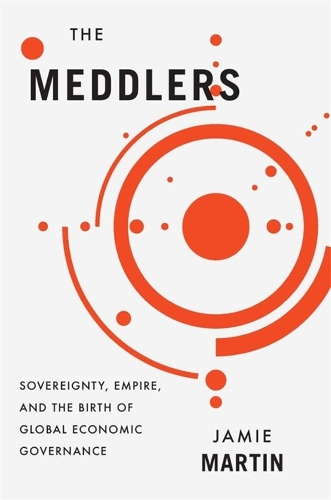
Книга The Meddlers: Sovereignty, Empire, and the Birth of Global Economic Governance
“The Meddlers is an eye-opening, essential new history that places our international financial institutions in the transition from a world defined by empire to one of nation states enmeshed in the world economy.”
—Adam Tooze, Columbia University
An award-winning history traces the origins of global economic governance—and the political conflicts it generates—to the aftermath of World War I.
International economic institutions like the International Monetary Fund and World Bank exert incredible influence over the domestic policies of many states. These institutions date from the end of World War II and amassed power during the neoliberal era of the late twentieth century. But as Jamie Martin shows, if we want to understand their deeper origins and the ideas and dynamics that shaped their controversial powers, we must turn back to the explosive political struggles that attended the birth of global economic governance in the early twentieth century.
The Meddlers tells the story of the first international institutions to govern the world economy, including the League of Nations and Bank for International Settlements, created after World War I. These institutions endowed civil servants, bankers, and colonial authorities from Europe and the United States with extraordinary powers: to enforce austerity, coordinate the policies of independent central banks, oversee development programs, and regulate commodity prices. In a highly unequal world, they faced a new political challenge: was it possible to reach into sovereign states and empires to intervene in domestic economic policies without generating a backlash?
Martin follows the intense political conflicts provoked by the earliest international efforts to govern capitalism—from Weimar Germany to the Balkans, Nationalist China to colonial Malaya, and the Chilean desert to Wall Street. The Meddlers shows how the fraught problems of sovereignty and democracy posed by institutions like the IMF are not unique to late twentieth-century globalization, but instead first emerged during an earlier period of imperial competition, world war, and economic crisis.
"Martin’s impressive new book, The Meddlers, considers the League of Nations and other interwar precursors of ‘neutral’ institutions of doux commerce to show how closely the ‘birth of global economic governance’ was entangled with empire." - London Review of Books
"Few standard accounts of international economic history hold up to scrutiny in Jamie Martin’s bold history of economic governance." - Times Literary Supplement
"Martin offers an alternative perspective on the crisis of global economic governance today, showing how the interventionist powers of the IMF and the World Bank have all along been rooted in empire and colonialism." - The Nation
"Explains how the unparalleled economic coordination among the allies during World War I (‘a system of government purchasing, price-fixing, distribution and transport’) laid the groundwork for attempted delegations of sovereignty after war ended. Martin recounts in fascinating detail how these institutions in the 1920s imposed austerity disguised as debt relief, and the hapless efforts of smaller debtor nations and Germany to resist." - American Prospect
"Martin’s account is well worth taking seriously, and not only because it allows us to expose the rhetoric of cooperation and development that justifies an exploitative and unequal international order. Indeed, to challenge capitalism on a local and national level, we need to understand how the capitalist class organizes and projects its power internationally." - Jacobin
"[The Meddlers] arrives at a critical moment, as many countries are asking the IMF and other international institutions to help them address economic and environmental crises…Martin offers a helpful economic and social analysis of the history of international intervention in sovereign economies." - Commonweal
"Martin’s research skills are impeccable, and his granular method allows us to see the actions of the interwar international organizations unfolding in real time…Remarkable." - H-Diplo
"Fills a major gap in scholarship that will be essential to historians, legal scholars, economists and political scientists who study global economic governance…Required reading for policymakers and advocates looking to fully understand a system in need of deep reform." - LSE Review of Books
"Martin has written a fascinating new book on the little known institutions that created international control over the world economy…His ability to synthesise so many different sources into one story is impressive." - Business History
"The many rich veins of potential research inspired by Martin’s book are testament to its comprehensive scope and thoughtful analysis. This is a first-rate work of international history." - Diplomatic History
"Very interesting." - Enlightened Economist
"Overall, the book provides a wealth of historical detail and perspective about the development of these [international financial institutions], and students of history will find much to learn from it." - The Developing Economies
"[A] comprehensive history of the formation of international financial institutions, which opens at the close of the Great War, a quarter century before Bretton Woods. [Martin’s] book is a deeply researched contextualization of what led to the 1944 New Hampshire conclave that birthed the IMF and World Bank." - Finance & Development
"In his engaging and clear-eyed new book, Jamie Martin traces the origins of what he calls ‘global economic governance’…Complementing histories of the interwar economy that have focused on trade and finance, Martin offers a more integrated and holistic picture…Readers will find much to grapple with." - H-Soz-Kult
"Extraordinary… Martin shows how international institutions intervened in global capital and commodity markets in ways that shaped and limited domestic policies, especially for states with uncertain or partial sovereignty." - Business History Review
"Students of economic history, international development and international law will benefit from Martin’s deeply researched history of these organizations and their predecessors. The Meddlers includes profiles of their architects, stories of resistance to their interference, and questions of institutional legitimacy that remain relevant today. The book is likely to teach analysts, economists and policy-makers something new about their current or former employers." - International Affairs
"Insightful and innovative…Martin reconstructs with precision and analytical depth the salient moments of the transformations that particularly affected the functioning of the League of Nations and of the first international bank." - History of Economic Thought and Policy
"The Meddlers is a forceful contribution to an expanding field of thought-provoking historical examinations of ‘self-determination,’ especially during global capitalism’s first half of the twentieth century." - Toynbee Prize Foundation (website)