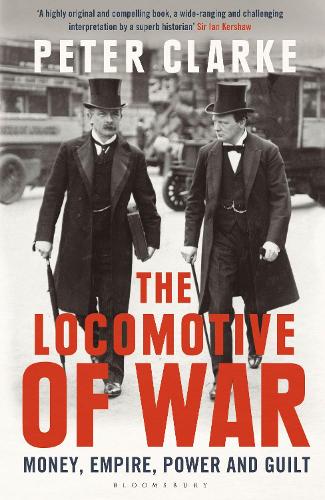
Книга The Locomotive of War: Money, Empire, Power and Guilt
A fresh and fascinating reappraisal of the first half of the twentieth century from one of our foremost historians
A Times Literary Supplement Book of the Year for 2017 ‘War, comrades,’ declared Trotsky, ‘is a great locomotive of history.’ He was thought to be acknowledging the opportunity the First World War had offered the Bolsheviks to seize power in Russia in 1917. Twentieth-century warfare, based on new technologies and mass armies, certainly saw the locomotive power of war geared up to an unprecedented level. Peter Clarke explores the crucial ways in which war can be seen as a prime mover of history in the twentieth century through the eyes of five major figures. In Britain two wartime prime ministers – first David Lloyd George, later Winston Churchill – found their careers made and unmade by the unprecedented challenges they faced. In the United States, two presidents elected in peacetime – Woodrow Wilson and Franklin Roosevelt – likewise found that war drastically changed their agenda. And it was through the experience of war that the economic ideas of John Maynard Keynes were shaped and came to exert wide influence. When the United States entered the First World War in 1917, President Wilson famously declared: ‘The world must be made safe for democracy.’ This liberal prospectus was to be tested in the subsequent peace treaty, one that was to be bitterly remembered by Germans for its ‘war guilt clause’. But both in the making of the war and the making of the peace the issue of guilt did not suddenly materialise out of thin air. As Clarke’s narrative shows, it was an integral component of the Anglo-American liberal tradition. The Locomotive of War is a forensic and punctilious examination of both the interplay between key figures in the context of the unprecedented all-out wars of 1914–18 and 1939–45 and the broader dynamics of history in this extraordinary period. Deeply revealing and insightful, it is history of the highest calibre.
"Plausible and enormously engaging … An old-fashioned kind of history, brimming with ideas and based on scrupulous research, and it is all the better for it … Clarke is such an acute writer that almost every paragraph has something surprising to say. Perhaps above all, he has an unrivalled ability to leaven serious political analysis with gossipy anecdotal details" - Sunday Times
"It is a tribute to his protean personality, and to Clarke's diligent scholarship and elegant narration, that every aspect of his [Churchill's] life remains eternally fascinating" - Sunday Telegraph on Mr Churchill's Profession
"Fascinating, erudite and witty" - Guardian on Mr Churchill's Profession
"Clarke gives us the fullest account yet of Churchill's hair-raising attitude towards money ... A scholarly gem: polished and sparkling and a lasting contribution to our understanding of Churchill" - Literary Review on Mr Churchill's Profession
"Engrossing … With effortless command of detail and pointed anecdote, Clarke tells the story through the biographies and interactions of leading members of a gilded elite on both sides of the Atlantic" - Prospect
"As a skilled biographer Clarke has a keen eye for the telling anecdote and a finely honed gift for the brilliant vignette. All of this stands him in good stead as he traces the fortunes of liberalism in Britain and the United States through the prisms of David Lloyd George and Woodrow Wilson, Franklin Delano Roosevelt and Winston Churchill, and, more specifically, Keynes" - Times Literary Supplement
"Clarke reveals the subtle interplay between personalities and history ... original, intriguing and sometimes disturbing" - Times Literary Supplement 'Books of the Year'