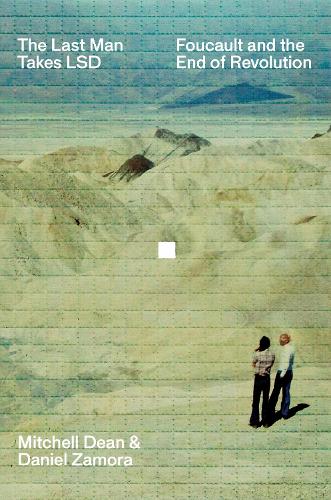
Книга The Last Man Takes LSD: Foucault and the End of Revolution
How Michel Foucault, drugs, California and the rise of neoliberal politics in 1970s France are all connected
In May 1975, Michel Foucault took LSD in the desert in southern California. He described it as the most important event of his life which would lead him to completely rework his History of Sexuality. His focus now would not be on power relations but on the experiments of subjectivity, and the care of the self. Through this lens he would reinterpret the social movements of May 68 and position himself politically in France in relation to the emergent ant-totalitarian and anti-welfare state currents. He would also come to appreciate the possibilities of autonomy offered by a new force on the French political scene that was neither of the Left nor the Right: neoliberalism.
"The contribution of this important essay is to place Foucault's thought on neoliberalism in its political context of the time. This is the whole point of this essay, all the more fascinating since it offers an overview of the work on Foucault, in particular on its relation to neoliberalism." - Politis
"In The Last Man Takes LSD, the sociologists Mitchell Dean and Daniel Zamora meticulously examine the turning point of the seventies to take a critical look at Foucault's political heritage, and to revive the debate on his relationship to the neoliberal school of thought." - Les Inrocks
"A volume that offers us an overview of the political field that gave rise to Foucault's ideas. The two authors enrich the debate by proposing to consider the alleged Foucaultian sympathy for neoliberalism as a moment where power seemed to criticize himself, making possible, on the one hand, a policy finally free from the conquest of the State and institutions, and on the other, the idea of an autonomous constitution of oneself - or, what would today be inexorably described as an entrepreneur of the self." - Il Manifesto
"Michel Foucault saw neoliberalism as an opportunity to think about the revitalization of the left in civil society. The authors Daniel Zamora and Mitchell Dean explain why he lost sight of its authoritarian dimension." - Woz
"When I say something," Foucault claimed, "I am speaking to the present." How ironic that so little of the discussion around Foucault, particularly in the United States, has focused on his present. In their riveting study, Dean and Zamora do just that, putting Foucault in dialogue not only with the anti-Marxist New Philosophers of the 1970s but also with a neoliberalism emerging from within French socialist circles after 1968. The result is a completely unexpected Foucault, more rooted in the struggles of his own time, yet still speaking, as a cautionary tale, to our own. One would be hard pressed to find a better book on such a complex thinker or a more compulsively readable introduction to the contradictory politics of the left in our current moment. - Corey Robin
"The Last Man Takes LSD is the best account of Foucault's engagement with neoliberalism. The book raises a number of intriguing questions, not the least of which is: What is left?" - The Battleground
"Dean and Zamora do an excellent job contextualizing Foucault's research and ideas in his final years. They methodically trace the nuances of the era's prickly political climate, creating a sympathetic portrait of Foucault's promotion of a damaging and - for a thinker who fruitfully explored power and exploitation - self-defeating philosophical turn." - Los Angeles Times
"Not just a brilliant and well-timed exploration of Foucault's intellectual trajectory ... it is also a necessary addition to the literature that has emerged over the past five years on the intellectual history of neoliberalism." - New Statesman
"The Last Man Takes LSD questions the lingering significance of Foucault's work today, highlighting a greater gap in Foucauldian thought: the absence of a well-developed theory of the state." - The Point
"A fascinating study of Foucault's American years." - Spectator
"Compelling." - Foucault Studies