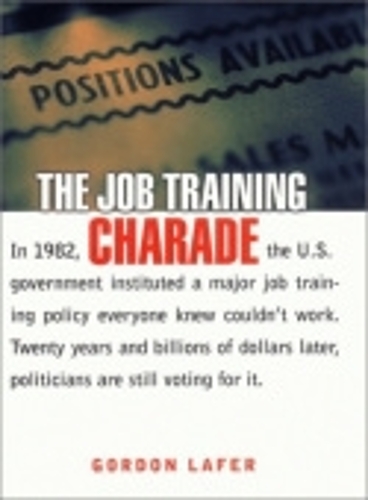
Книга The Job Training Charade
Job training has long been promoted as a central policy response to poverty and unemployment. Both Democrats and Republicans have trumpeted training as the answer to everything from welfare to NAFTA. The Job Training Charade provides a comprehensive critique showing that training has been a near-total failure. Even more dramatically, the book shows how politicians have ignored repeated reports of the program’s failure, and have kept funding a policy they know cannot work. Gordon Lafer first examines the economic assumptions and track record of training policy. He goes on to provide a political analysis of why job training has remained so popular despite widespread evidence of its economic failure. The author concludes that job training functions less as an economic prescription aimed at solving poverty than as a political strategy aimed at managing the popular response to economic distress. The Job Training Charade is a landmark book showing how a bipartisan consensus may coalesce behind a phantom policy that serves political needs while ignoring economic realities.
"For those who follow employment policy, it was no surprise that President Bush's State of the Union address called for more job training as the solution for unemployment. For 20 years, every jobs crisis—whether inner-city poverty, jobs lost due to the North American Free Trade Agreement, or loggers put out of work by the spotted owl—has been met with calls for retraining. Whatever the problem, it seems, job training is the answer. The only trouble is, it doesn't work, and the government knows it."—Gordon Lafer in an editorial, Los Angeles Times, January 25, 2004
Job training has long been promoted as a central policy response to poverty and unemployment. Both Democrats and Republicans have trumpeted training as the answer to everything from welfare to NAFTA. The Job Training Charade provides a comprehensive critique showing that training has been a near-total failure. Even more dramatically, the book shows how politicians have ignored repeated reports of the program's failure, and have kept funding a policy they know cannot work.
Gordon Lafer first examines the economic assumptions and track record of training policy. He goes on to provide a political analysis of why job training has remained so popular despite widespread evidence of its economic failure. The author concludes that job training functions less as an economic prescription aimed at solving poverty than as a political strategy aimed at managing the popular response to economic distress. The Job Training Charade is a landmark book showing how a bipartisan consensus may coalesce behind a phantom policy that serves political needs while ignoring economic realities.
"
In The Job Training Charade, Lafer attacks the U.S. economic policy that calls for the advancement of the skills and education of American workers as their way out of poverty.... Agree or not, readers will be challenged by this criticism of the underpinnings of American labor policy.
" - Working Knowledge"
Lafer suggests there are other things the government could do that would help more than training. Among those are restricting the use of permanent-temp workers; stopping competition from goods made under illegal conditions in other countries; increasing the minimum wage; and capping prescription drug and health care costs.
" - Silicon Valley/San Jose Business Journal"
Lafer's intention is to provide 'the first comprehensive critique of the history, track record, and economic assumptions underlying' American job training policies since the early 1960s (page 1). His book delivers on that promise. From cover to cover, it is an unrelenting, tough, thoroughly documented, passionately argued, and uncompromising indictment of the politicians, powerful economic interests and bureaucrats he holds responsible for the policies he so roundly condemns.
" - Journal of Industrial Relations"
In this well-written and hard-hitting critique, Lafer... argues that job training, as a federal policy response to poverty and unemployment, has been a near total failure.... This well-researched and insightful book should provoke widespread debate among scholars, politicians, policy makers, labor leaders, and employment and training professionals alike.
" - Choice