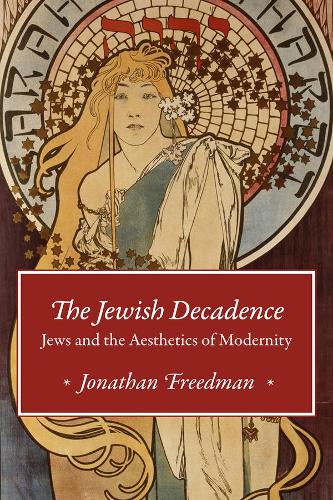
Книга The Jewish Decadence: Jews and the Aesthetics of Modernity
As Jewish writers, artists, and intellectuals made their way into Western European and Anglo-American cultural centers, they encountered a society obsessed with decadence. An avant-garde movement characterized by self-consciously artificial art and literature, philosophic pessimism, and an interest in nonnormative sexualities, decadence was also a smear, whereby Jews were viewed as the source of social and cultural decline. In The Jewish Decadence, Jonathan Freedman argues that Jewish engagement with decadence played a major role in the emergence of modernism and the making of Jewish culture from the 1870s to the present.
The first to tell this sweeping story, Freedman demonstrates the centrality of decadence to the aesthetics of modernity and its inextricability from Jewishness. Freedman recounts a series of diverse and surprising episodes that he insists do not belong solely to the past, but instead reveal that the identification of Jewishness with decadence persists today.
"It is chock-full of exciting and provocative ideas, but it is also just plain fun — something akin to Freedman leading the reader by the hand on a tour of a cultural landscape that he knows like the back of his hand." - Los Angeles Review of Books
"This is a profoundly important book in Jewish Studies, as well as among the cultural and literary criticism of its artistic subject." - Religion and the Arts
"Erudite, gossipy, nuanced, funny, and moving. . . Freedman serves as collector culling materials from a wide array of sources, arranging them into an often dizzying but unfailingly interesting and almost always entirely persuasive account that supports his thesis, each time from a different direction." - Victorian Studies
"Freedman’s argument, that Jewish novelists, poets, actors, and philosophers reworked the
discourse of decadence, which often linked Jewishness to decline, to their own ends in order
to generate a Jewish response to the conditions of modernity, is compelling. More importantly,
it offers a model of how work on afterlives and transnational circulation can avoid the trap of
thinking in terms of unidirectional influence and attend to the agency and creativity of those
influenced." - Journal of British Studies
"A book that transforms our experiences of familiar works and encourages us to carry on the work of Jewish cultural studies, following the example of one of its most gifted practitioners." - Reading Religion