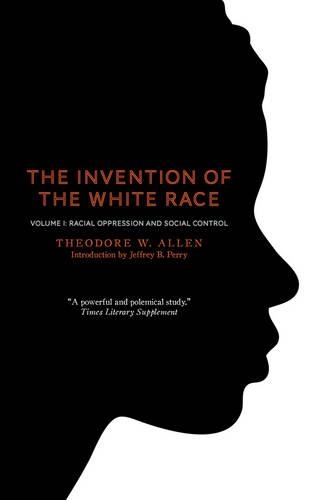
Книга The Invention of the White Race, Volume 1: Racial Oppression and Social Control
Groundbreaking analysis of the birth of racism in America
When the first Africans arrived in Virginia in 1619, there were no "white" people there. Nor, according to colonial records, would there be for another sixty years. In this seminal two-volume work, The Invention of the White Race, Theodore W. Allen tells the story of how America's ruling classes created the category of the "white race" as a means of social control. Since that early invention, white privileges have enforced the myth of racial superiority, and that fact has been central to maintaining ruling-class domination over ordinary working people of all colors throughout American history.
Volume I draws lessons from Irish history, comparing British rule in Ireland with the "white" oppression of Native Americans and African Americans. Allen details how Irish immigrants fleeing persecution learned to spread racial oppression in their adoptive country as part of white America.
Since publication in the mid-nineties, The Invention of the White Race has become indispensable in debates on the origins of racial oppression in America. In this updated edition, scholar Jeffrey B. Perry provides a new introduction, a short biography of the author and a study guide.
"A powerful and polemical study." - Times Literary Supplement
"A real tour de force, a welcome return to empiricism in the subfield of race studies, and a timely reintroduction of class into the discourse on American exceptionalism." - Times Higher Education Supplement
"An intriguing book that will be cited in all future discussions about the origins of racism and slavery in America." - Labor Studies Journal
"A richly researched and highly suggestive analysis ... Indispensable for readers interested in the disposition of power in Ireland, in the genesis of racial oppression in the U.S., or in the fluidity of 'race' and the historic vicissitudes of 'whiteness.'" - Choice
"The Invention of the White Race's contributions to the debates on notions of a 'white race' are unquestionable and its relevance not simply for scholars of American history but for those interested in notions of race and class in any historical and geographical setting is beyond doubt." - Labour History Review
"Theodore W. Allen has enlisted me as a devoted reader." - Metro Times Literary Quarterly
"The most comprehensive and meticulously documented presentation of the historical, or as he calls it, 'sociogenic' theory of racial oppression." - Freedom Road Magazine
"Immigration historians should be particularly interested in Allen's analysis of how the Irish, victims of racial oppression at home, learned that they were 'white' once they crossed the Atlantic and became ... supporters of a system of racial oppression in the United States." - Journal of American Ethnic History
"The transition from being poor, dispossessed, Catholic and oppressed when in Ireland, to fully ordained members of the 'white race' when in America, with all the privileges, rights and immunities appertaining thereto, illustrates the sociological relativity of notions of race ... [and] confirms Allen's preference for a 'sociogenic' understanding of racial oppression rooted in sociological processes, rather than 'phylogenic' or genetic interpretations." - Ethnic & Racial Studies (UK)
"Allen, ... an independent scholar ... has pursued an idea across the frontier of conventional specializations, supported in his labours by a belief that to determine the origin of white racism will contribute to its eradication. It is difficult to envisage such a work being produced in the wasteland of contemporary academic life, . . ." - Ecumene (U. K.)
"Allen's use of the Irish example lends support to the argument that race is a social construction. A strength of Allen's book is his effort to view race apart from biology, to see racial categories as ever-changing social conventions and not as immutable classifications fixed in nature or the human psyche." - Virginia Magazine of History and Biography
"Allen is concerned here with ... a comparative analysis of racial oppression in Ireland and in the United States ... and the shift in identity among Irish immigrant Catholics, who moved from a group oppressed on racial grounds in Ireland to one defined as 'white' in the United States ... What pulls the entire discussion together is the notion of 'Social Control.' Allen argues that racial oppression (racial social control) is one of various mechanisms a ruling elite can utilize to protect its position in society." - Contemporary Sociology
"Allen champions the superiority of socioeconomic over psychocultural approaches to the study of race and slavery ... [and] notes, "only by 'understanding what was peculiar about the Peculiar Institution can one know what is exceptionable about 'American Exceptionalism." - Journal of American History
"Allen sees race as an invention-and he knows who invented it. Racial slavery was the creation of colonial power (or a ruling class, or the bourgeoisie), and what was done in North America was analogous to what was done in Ireland. So the struggle against capitalism and the struggle against race are part of the same campaign." - Tribune (London)
"Allen's work adds a level of detail often overlooked. He incorporates 'white' people into the discussion, and not just as proponents and perpetrators of slavery. He shows how most ... whites perpetuated their own subordination by rejecting alliances with people of color." - Logos