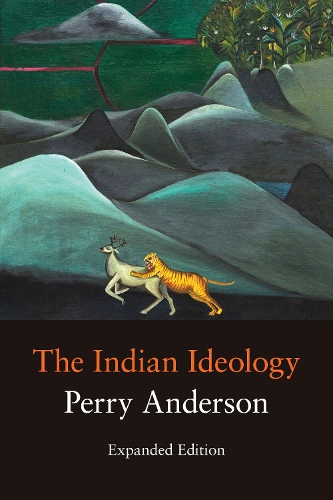
Книга The Indian Ideology
New expanded edition with a postscript on India under Modi
The historiography of modern India is largely a pageant of presumed virtues: harmonious territorial unity, religious impartiality, the miraculous survival of electoral norms in the world's most populous democracy. Even critics of injustices within Indian society still underwrite such claims. But how well does the 'Idea of India' correspond to the realities of the Union?
In an iconoclastic intervention, Marxist historian Perry Anderson provides an unforgettable reading of the Subcontinent's passage through Independence and the catastrophe of Partition, the idiosyncratic and corrosive vanities of Gandhi and Nehru, and the close interrelationship of Indian democracy and caste inequality.
The Indian Ideology caused uproar on first publication in 2012, not least for breaking with euphemisms for Delhi's occupation of Kashmir. This new, expanded edition includes the author's reply to his critics, an interview with the late Praful Bidwai of the Indian weekly Outlook, and a postscript on India under the rule of Narendra Modi. Anderson considers whether his regime is as much of a break with the practices and thought processes of Congress rule as is generally supposed.
"A magnificent achievement. It is a product of his ability, near-unique in today's world of ideas, to distill a country's history and politics into a few thousand words that are at once combative and informative" - Business Standard, New Delhi
"Anderson's scepticism towards India's claim to be a postcolonial democracy uniquely untainted by repression, emergency powers and other dark arts of territorial "unity" is timely" - Prospect
"Well sourced and artfully crafted, offering a comprehensive history of India's ideology" - Jacobin
"Anderson is unanswerable when he points to a consistent Indian pattern of silence, evasion, and distortion about India's military occupation of Kashmir and its attendant regime of extrajudicial execution, torture, and detention. Many readers will be struck by the evidence Anderson adduces of the insidious dominance of upper-caste Hindus in every realm of social and political life and by his portrait of the primordial politics of caste and religion, which have enshrined a patrimonial state built on nepotism and dynasty worship. Admirers of Gandhi and Nehru will encounter many awkward facts, especially regarding their roles in the partition of India, a calamity usually blamed on British colonial administrators and Indian Muslim leaders" - Foreign Affairs
"Exposes some substantial faultlines in recent Indian writing about India and with some justice questions the emerging consensus around India's democratic successes" - Times Literary Supplement
"With his sharp and lucid prose, Anderson strips away many of the liberal myths surrounding Mohandas Gandhi, Jawaharlal Nehru, and Indian democracy itself. His incisive insights, his sweeping vision, his invocation of telling detail are all here in full measure" - Critical Asian Studies