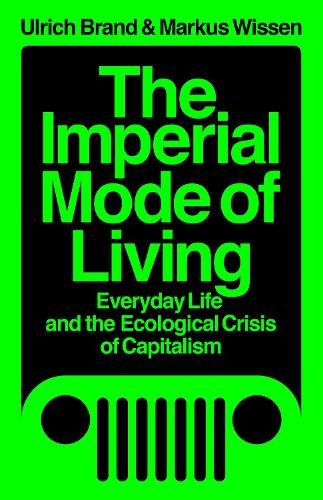
Книга The Imperial Mode of Living: Everyday Life and the Ecological Crisis of Capitalism
Our Unsustainable Life: Why We Can't Have Everything We Want
With the concept of the Imperial Mode of Living, Brand and Wissen highlight the fact that capitalism implies uneven development as well as a constant and accelerating universalisation of a Western mode of production and living. The logic of liberal markets since the 19thCentury, and especially since World War II, has been inscribed into everyday practices that are usually unconsciously reproduced. The authors show that they are a main driver of the ecological crisis and economic and political instability.
The Imperial Mode of Living implies that people's everyday practices, including individual and societal orientations, as well as identities, rely heavily on the unlimited appropriation of resources; a disproportionate claim on global and local ecosystems and sinks; and cheap labour from elsewhere. This availability of commodities is largely organised through the world market, backed by military force and/or the asymmetric relations of forces as they have been inscribed in international institutions. Moreover, the Imperial Mode of Living implies asymmetrical social relations along class, gender and race within the respective countries. Here too, it is driven by the capitalist accumulation imperative, growth-oriented state policies and status consumption. The concrete production conditions of commodities are rendered invisible in the places where the commodities are consumed. The imperialist world order is normalized through the mode of production and living.
"The highly readable book by Brand and Wissen exposes an internal contradiction fraught with consequences: the imperial mode of living undermines its own operating conditions. Currently, the dominant reaction to this fact consists of desperate attempts to secure the exclusivity of this mode of living even under altered conditions." - Frankfurter Allgemeine Zeitung
"The facts of the "imperial mode of living" are nothing new. The merit of the authors lies in showing its related problems broadly, well founded in theory and substantiated by empirical material." - Frankfurter Rundschau
"Developing a counter-hegemony to the imperial mode of living would mean articulating both structural and everyday alternatives. Brand and Wissen call for seeking out confrontation with the elites in contested societal (nature) relations and countering the imperial mode of living with a solidary one." - analyse & kritik
"Empathy for the worries of people who are situated well above average on a global scale, but are increasingly unsettled in their sphere of life, would be needed for the transformation-oriented left, if it were to take a hegemonic project seriously." - Austrian Journal of Political Science
"An explosive book that not only helps in understanding the multiple crises of our times, but also shows approaches for overcoming them." - die tageszeitung
"The book shows that a sound analysis of society is not an academic end it itself but has a high relevance for the political discourse." - GAIA
"Using the term "mode of living", the authors succeed in defining the embedding of global power relations in the everyday actions of people in the North without raising moral accusations. [.] The imperial mode of living has the hallmarks of compulsion, but at the same time enables, creates conveniences and expands scopes of action. While it can be sustained only for the price of intensifying economic and ecological crises, it contributes to the stabilization of the societies of the North, including their injustices, and remains attractive for those excluded, whose hope is not pinned on overcoming the imperial conditions, but on participating in the exclusive privileges." - express
"Brand/Wissen conceive the term "mode of living" [...] as a category of systematic connections between action and structure. The term connects the analysis of the everyday practices people use to reproduce social conditions to a critique of social structures that make just these practices appear to be the conditions for a good life [...]. Norms for modes of production and consumption are embedded in these practices just as much as are forms of state regulation that arose from social conflicts. In other words, the imperial mode of living forms part of a hegemonic combination that does not confront the social actors as something external but constitutes them as subjects and conveys a capacity for action to them, which they adopt and reproduce in their everyday practices." - Politikum
"With their effort to start with the daily normality of the imperial mode of living, Ulrich Brand and Markus Wissen managed an important strike, especially in the political realm." - Sozialismus
"If you want to understand the multiple crises of our times and are searching for answers, you must read this book. It is an exceptional proof of the practical value of political science." - Südwestrundfunk. Die Buchkritik
"An accessible and deep examination of imperialism's historical and present construction of a global economy designed to not only dominate the peoples and nations outside the capitalist core, but also to keep that economy's ecological destructiveness in those nations, too." - CounterPunch
"A book for these times ... The Imperial Mode of Living not only offers a novel grasp of the links of everyday life to crises and inequalities on a global scale, but it also takes a stand for the necessity of politics from below." - LSE Review of Books