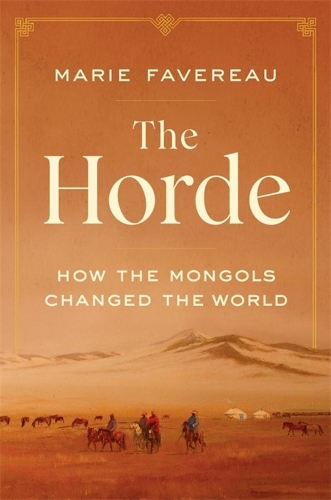
Книга The Horde: How the Mongols Changed the World
2021 Cundill History Prize Finalist
A Financial Times Best Book of the Year
A Spectator Best Book of the Year
A Five Books Best Book of the Year
“Outstanding, original, and revolutionary. Favereau subjects the Mongols to a much-needed re-evaluation, showing how they were able not only to conquer but to control a vast empire. A remarkable book.”
—Peter Frankopan, author of The Silk Roads
The Mongols are widely known for one thing: conquest. In the first comprehensive history of the Horde, the western portion of the Mongol empire that arose after the death of Chinggis Khan, Marie Favereau shows that the accomplishments of the Mongols extended far beyond war. For three hundred years, the Horde was no less a force in global development than Rome had been. It left behind a profound legacy in Europe, Russia, Central Asia, and the Middle East, palpable to this day.
Favereau takes us inside one of the most powerful sources of cross-border integration in world history. The Horde was the central node in the Eurasian commercial boom of the thirteenth and fourteenth centuries and was a conduit for exchanges across thousands of miles. Its unique political regime—a complex power-sharing arrangement among the khan and the nobility—rewarded skillful administrators and diplomats and fostered an economic order that was mobile, organized, and innovative. From its capital at Sarai on the lower Volga River, the Horde provided a governance model for Russia, influenced social practice and state structure across Islamic cultures, disseminated sophisticated theories about the natural world, and introduced novel ideas of religious tolerance.
The Horde is the eloquent, ambitious, and definitive portrait of an empire little understood and too readily dismissed. Challenging conceptions of nomads as peripheral to history, Favereau makes clear that we live in a world inherited from the Mongol moment.
"The Mongols have been ill-served by history, the victims of an unfortunate mixture of prejudice and perplexity…The Horde flourished, in Favereau’s fresh, persuasive telling, precisely because it was not the one-trick homicidal rabble of legend." - Wall Street Journal
"In medieval European times, the Mongols ruled a vast area of the Eurasian landmass stretching as far to the west as modern Ukraine. Favereau, a French specialist on nomadic empires, achieves the exceptional feat of writing about this era in a way that is accessible to general readers as well as scholarly." - Financial Times
"Fascinating…The Mongols were a sophisticated people with an impressive talent for government and a sensitive relationship with the natural world…An impressively researched and intelligently reasoned book that will be welcomed by historians of the Mongol Empire." - The Times
"A major achievement: it is thorough, accurate and complex, yet also accessible to a broad readership. Her blow-by-blow account of Mongol life and politics as one ruler falls and another rises is the most complete we have. Even better, the book is not solely focused on the Mongols. Favereau is an integrative historian committed to showing how the Horde influenced other peoples and shaped world history…Readers will enjoy the richness and clarity of The Horde." - Literary Review
"The first book to be devoted exclusively to the Golden Horde. It is at once a microhistory, dense with regional politics and war, and a survey of the Horde’s wider influence." - New York Review of Books
"A wonderful book…Suffice to say that in their politics, administration, family lives and, yes, their warfare, the Mongols were far more complicated than we think." - Bloomberg Opinion
"Favereau’s narrative is extremely rich in ethnographic detail and descriptions of succession battles, military campaigns, and internecine warfare. Favereau seeks to exonerate the Horde, which in her view is too often portrayed as merely a plundering force." - Foreign Affairs
"Eye-opening…A meaningful corrective to popular misconceptions about Mongols’ role in world history." - Publishers Weekly
"Rather than being the murderous mob depicted in film and popular history, the Mongol horde, this book reveals, was a complex Euro-Asian culture…[Favereau] dispels the myth that it was just a rampaging mass of warriors; it possessed great governing skills, was adept at social relationships, and remained a major force on the Eurasian landmass until it began to withdraw eastward after the Black Death." - Kirkus Reviews
"Although it had no permanent settlements and farmlands, the Horde was an advanced civilization as well as a formidable military power. Its leaders, all literate, ran a well-organized communications network that kept its far-flung population in constant touch…Reading The Horde is like immersing oneself in a sprawling epic." - Literary Review of Canada
"In The Horde, an ambitiously revisionist account of the Mongol Empire, Favereau presents the thirteenth- and fourteenth-century conquerors of the steppe as sophisticated stewards of globalism, rulers who practiced remarkable tolerance, and stimulated far-reaching economic growth." - Scroll
"Terrific—a really important reassessment of the origins of one of the great empires in history." - The Spectator
"[An] ambitious book with a huge range. It presents this world in its full complexity. It’s an incredibly compelling read and it changes the way you see the world." - Five Books
"The Horde is not the first history to challenge the depiction of the Mongol Empire as governed solely by ruthless conquerors and plunderers, but it is the most nuanced and comprehensive history." - New York Journal of Books
"An exciting new addition to a rich pool of contemporary scholarship in the field." - The Telegraph (India)
"A book that has profound ramifications for our understanding of European and Eurasian history…Irrefutably enthrones the Mongol Empire as one of the great drivers of global history." - Moscow Times