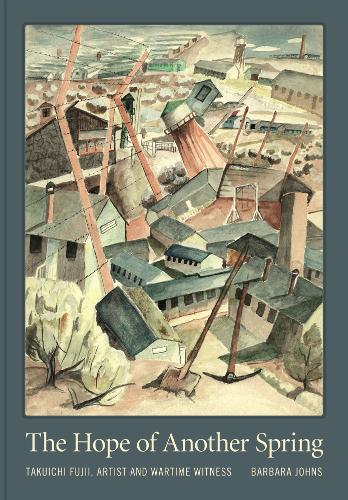
Книга The Hope of Another Spring: Takuichi Fujii, Artist and Wartime Witness
Like her subject Takuichi Fujii's diary in drawings and words, Barbara Johns's book records and interprets the events and, especially, the places of the forced incarceration and 'relocation' of the artist and his family during World War II as seen keenly by the Issei artist. But whereas Fujii's art implicitly evokes its current, historical, and cultural contexts, Johns's book, deeply researched, explicitly considers those contexts and the work of her predecessors in the scholarship of Asian American art history as well as archival details she herself has recovered. Including the translated text and drawings presented by the art historian Sandy Kita and his collaborator Honda Shojo, The Hope of Another Spring is itself a remarkable work combining visual, verbal, and scholarly art and the profound social criticism they make-for us, today. -- Stephen H. Sumida, author of And the View from the Shore: Literary Traditions of Hawai'i The visual camp diary left by Fujii offers a powerful and detailed portrait of life at the Puyallup and Minidoka camps. It is a gift to get such a close-up view. -- Greg Robinson, author of After Camp: Portraits in Midcentury Japanese American Life and Politics Although Fujii created an impressive body of paintings and drawings, he rarely displayed them publicly, so his work is virtually unknown. Barbara Johns makes an important contribution that expands our knowledge of Issei artists who were active in the mid-twentieth century. -- Jasmine Alinder, author of Moving Images: Photography and the Japanese American Incarceration
Takuichi Fujii (1891–1964) left Japan in 1906 to make his home in Seattle, where he established a business, started a family, and began his artistic practice. When war broke out between the United States and Japan, he and his family were incarcerated along with the more than 100,000 ethnic Japanese located on the West Coast. Sent to detention camps at Puyallup, Washington, and then Minidoka in Idaho, Fujii documented his daily experiences in words and art. The Hope of Another Spring reveals the rare find of a large and heretofore unknown collection of art produced during World War II. The centerpiece of the collection is Fujii’s illustrated diary that historian Roger Daniels has called “the most remarkable document created by a Japanese American prisoner during the wartime incarceration.”
Barbara Johns presents Takuichi Fujii’s life story and his artistic achievements within the social and political context of the time. Sandy Kita, the artist’s grandson, provides translations and an introduction to the diary. The Hope of Another Spring is a significant contribution to Asian American studies, American and regional history, and art history.
"
"While this book will be of particular interest to institutions in the Northwest (and Chicago), where Fujii was professionally active, it is broadly relevant and widely recommended as American History. Fujii’s diary is approachable and intimate documentation of an under-emphasized chapter and perspective, and Barbara Johns brings welcome attention and analysis to this artist and his work."
" - ARLIS/NA Reviews"
"The book and exhibition, together, shed a powerful new light on a troubling chapter in U.S. history. . . . Compelling as both artwork and history."
" - Seattle Times"
"This altogether beautiful book by noted Seattle-based art historian and curator Barbara Johns strikingly testifies to the oft-stated judgment that a picture is worth a thousand words."
" - Nichi Bei Weekly