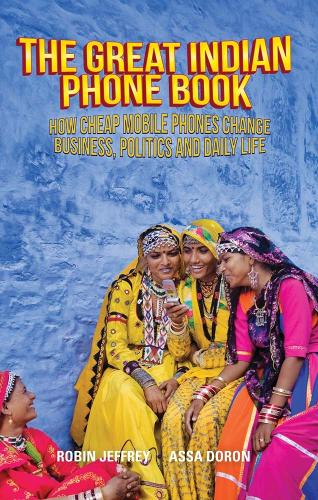
Книга The Great Indian Phone Book: How Cheap Mobile Phones Change Business, Politics and Daily Life
The cheap mobile phone is arguably the most significant personal communications device in history. In India, where caste hierarchy has reinforced power for generations, the disruptive potential of the mobile phone is even more striking than elsewhere. In 2001, India had 35 million telephones, only four million of them mobiles. Ten years later, it had more than 800 million phone subscribers; more than 95 per cent were mobile phones. In a decade, communications in India have been transformed by a device that can be shared by fisherfolk in Kerala, boatmen in Banaras, great capitalists in Mumbai and power-wielding politicians and bureaucrats in New Delhi. Village councils banned unmarried girls from having mobile phones. Families debated whether new brides should surrender them. Cheap mobile phones became photo albums, music machines and radios. Religious images and uplifting messages flooded tens of millions of phones each day. Pornographers and criminals found a tantalising new tool. In politics, organisations with cadres of true believers exploited a resource infinitely more effective than telegrams, postcards and the printing press for carrying messages to workers, followers and voters. Jeffrey and Doron focus on three groups - controllers: the bureaucrats, politicians and capitalists who wrestle over control of radio frequency spectrum; servants: the marketers, agents, technicians, tower-builders, repairers and second-hand dealers who carry mobile phones to the masses; and users: the politicians, activists, businesses and households that adapt the mobile phone to their needs. The book probes the whole universe of the mobile phone - from the contests of great capitalists and governments to control radio frequency spectrum, to the ways ordinary people build the troublesome and addictive device into their daily lives.
"This superb new book reminds us how little we have explored the new landscape of opportunity, aspiration and, inevitably, disappointment that mobile phones have opened up in India." - Bloomberg
"A comprehensive look at what cellphones have meant for India. Their story covers everything from family relations and gender barriers to terrorism and the relations of citizens to the state. Out of what could have been a dry study packed with statistics the authors have managed to write a superb book--informative, insightful, witty--that is essential reading for anyone interested in India, or technological change, or good stories told with clarity and purpose." - Wall Street Journal
"This book is, overall, a very well researched, comprehensive and timely contribution to understanding the consequences of mobile phone technology, and its engaging and accessible style means it is likely to appeal to a variety of audiences." - Times Higher Education
"How did India go from being a country in which making phone calls was exquisite torture to the world's second-largest market for mobile phones in just ten years? And what did this rapid proliferation of communication do to Indian society? Assa Doron's and Robin Jeffrey's ambitious survey is a good place to find some answers. ... 'The Great Indian Phone Book' is actually two books in one. The first half is a whirlwind recap of how India was connected, told simply and with a wealth of numbers. The second is an ethnographic study that dives into the intricacies of Indian society without pretending to be comprehensive. ... [T]he strength of the book lies in its repeated emphasis on technology as something that does not eliminate political and social structures, though it may modify them." - The Economist
"a riveting account of India's wholesale uptake of mass telecommunication... The Great Indian Phone Book is as packed with thrills as it is with anecdotes and information. This is that rarest of literary marriages, scholarship with a light touch." - Asian Affairs
"In this fine anthropological study, Doron and Jeffrey look at how the introduction and current widespread use of the cell phone has altered life in one of the world s largest countries. In 1991, there were 165 people for every telephone in India, but today this ratio is 2:1 or less. The authors cover the technical aspects of this rapid expansion, as well as some of the corruption involved, including the arrest of a former minister of communications. More compelling, though, are the stories of individual citizens and the changes, not always for the better, wrought by mobile phone ownership. For example, the growth of the cell phone industry resulted in new jobs in sales, tower construction, manufacturing, and repair, both by corporate employees and street craftsmen. The 2007 elections in Uttar Pradesh were profoundly affected by motivated citizens using their mobiles. In traditional households, it isn't uncommon for new brides to have their phones confiscated by their in-laws for modesty's sake. Pornography, terrorism, and surveillance abuses are just some of the criminal acts abetted by cell phones. This rich study reveals much about modern India and should be read by both students and scholars of technology and South Asia." - Publishers Weekly
"A major achievement. The authors have explored every facet of this topic thoroughly, setting everything in its complex historical context. They demonstrate knowledge and true understanding of the historical and social issues. What is more, their work is eminently readable." - The Round Table: The Commonwealth Journal of International Affairs
"[I]n this book a historian and an anthropologist illustrate the titanic impact of the telecommunications industry on the largest democracy in the world . . . where there has been more dramatic growth in the spread of mobile phones than in any other region in the world. . . . They describe the unique potency of a cheap mobile phone that puts an immensely disruptive device within reach of the poor. . . . This is an important book that can usefully be read by students, social scientists, and business managers--indeed, by anyone interested in change and its effect on developing and complex societies." - Finance & Development
"In 'The Great Indian Phone Book', Robin Jeffrey (a political scientist) and Assa Doron (an anthropologist) have produced a riveting study that traces the effects of mobile technology on the lives of everyday people, from the fishermen who can now more effectively set the price of their catch to the electronic technicians who make a living from repairing banged-up handsets. . . . Jeffrey and Doron offer a timely reminder that mobile cultures are moving in many directions simultaneously. With convergence, the technological gap between the mobile and other devices is closing--but the uses to which the mobile is put around the world remain impossibly diverse." - Inside Story
"This book takes us on India's journey towards modernity through the story of the rise of the mobile telephone, tracking the incredible social, economic and political changes that have accompanied the explosion of mobile communications in India." - Contemporary South Asia
"This book takes a comprehensive, and highly entertaining look at the mobile phone revolution and its implications for India . . . The authors . . . have clearly succeeded in their central mission of writing a book that would hold up its head as both sound scholarship and engaging reading." - The Commonwealth Lawyer